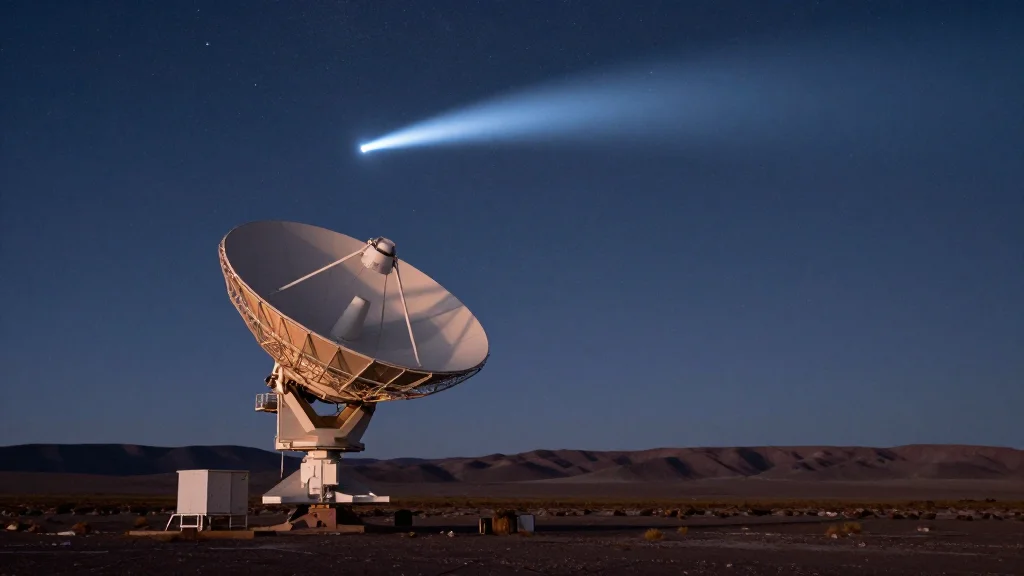
ALMA Finds Record Deuterium Levels in Interstellar Comet 3I/ATLAS, Hinting at Ultra‑Cold Birth

Why It Matters
The detection of extreme deuterium enrichment in 3I/ATLAS provides the first direct chemical evidence that some planetary systems form in environments far colder than our own. This challenges the prevailing view that most planet‑forming disks resemble the relatively warm conditions of the early Solar System. By confirming that interstellar objects can retain pristine isotopic signatures, the study opens a new avenue for probing the chemical evolution of the Milky Way and for testing models of galactic star formation. Moreover, the ability to measure deuterium remotely sets a precedent for future compositional studies of fleeting interstellar visitors. Beyond academic interest, the findings have practical implications for astrobiology and planetary defense. Understanding the water chemistry of interstellar bodies informs estimates of how much exotic material may be delivered to nascent planetary systems, potentially influencing the distribution of pre‑biotic compounds across the galaxy. As detection capabilities improve, scientists will be better equipped to assess the risk and scientific value of future interstellar objects that may intersect Earth's orbit.
Key Takeaways
- •ALMA measured deuterium in comet 3I/ATLAS at >40× Earth’s ocean levels
- •Formation temperature estimated below 30 K (‑243 °C)
- •Comet age inferred at 7‑12 billion years, predating the Sun
- •First direct isotopic fingerprint of an interstellar object
- •Results challenge existing models of planetary disk temperature and chemistry
Pulse Analysis
The 3I/ATLAS discovery marks a turning point in how astronomers use radio astronomy to interrogate the chemistry of interstellar visitors. Historically, the field relied on broadband photometry and limited spectroscopy, which could only infer bulk composition. By leveraging ALMA’s high‑resolution capabilities, researchers have demonstrated that isotopic ratios—once thought inaccessible for transient objects—can be measured with sufficient precision to discriminate between formation environments. This methodological leap will likely accelerate the integration of interstellar comet studies into mainstream planetary science, shifting the narrative from curiosity-driven observation to a systematic probe of galactic chemical diversity.
Historically, the two earlier interstellar objects offered tantalizing hints but no definitive chemical signatures. 3I/ATLAS fills that gap, providing a concrete data point that can be juxtaposed against Solar System comets and protoplanetary disk models. The >40× deuterium enrichment suggests that the comet formed in a dense, cold molecular cloud where fractionation processes favor heavy isotopes. This aligns with theoretical work predicting that early‑generation stars—forming when the galaxy was still metal‑poor—hosted colder disks, but empirical confirmation has been scarce. The new data therefore validates a key prediction of galactic chemical evolution and may prompt revisions to the temperature thresholds used in planet formation simulations.
Looking ahead, the ability to capture isotopic data quickly after discovery will become a competitive advantage for observatories worldwide. Facilities that can respond within days to a new interstellar detection will likely dominate the next wave of discoveries, especially as survey telescopes such as the Rubin Observatory increase the detection rate of fast‑moving objects. The scientific community will need coordinated observation campaigns, data‑sharing protocols, and perhaps dedicated rapid‑response time on flagship instruments. If these structures are put in place, the next decade could see a catalog of interstellar isotopic fingerprints, turning what was once a rare curiosity into a robust tool for mapping the chemical history of our galaxy.
ALMA Finds Record Deuterium Levels in Interstellar Comet 3I/ATLAS, Hinting at Ultra‑Cold Birth
Comments
Want to join the conversation?
Loading comments...