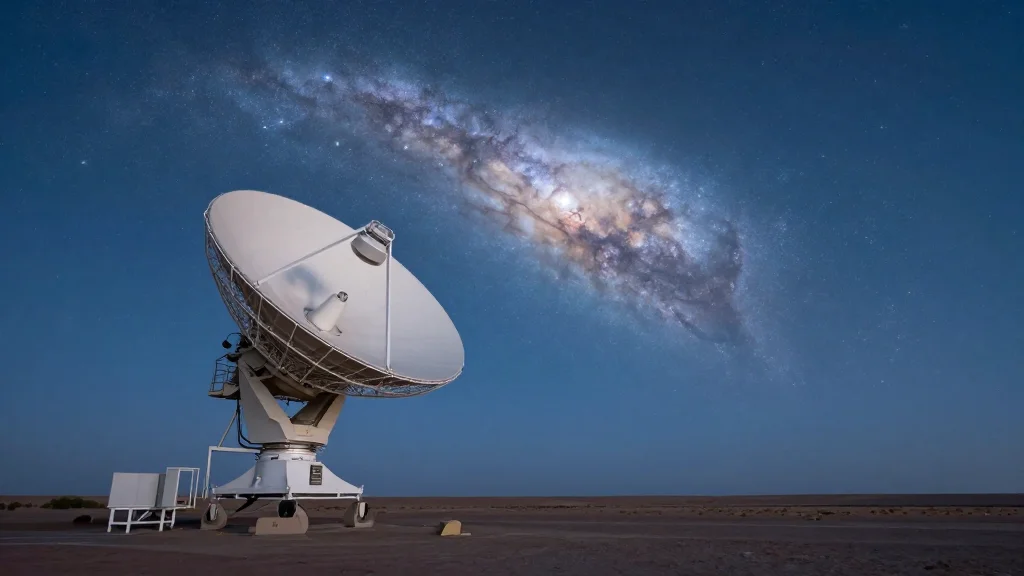
ALMA Reveals Giant Molecular Clouds Across Needle Galaxy's Full Disk
Why It Matters
Mapping molecular gas in a Milky Way analog provides critical benchmarks for star‑formation theories and galaxy‑evolution models, especially in edge‑on systems where vertical structure is observable.
Key Takeaways
- •ALMA mapped giant molecular clouds across Needle galaxy’s full disk
- •GMCs show thin vertical profile and align with major axis
- •13CO/12CO line ratio remains flat from 5 to 13 kpc
- •East Ring Pileup hosts starburst region comparable to 30 Doradus
Pulse Analysis
ALMA’s unprecedented sensitivity and angular resolution now allow astronomers to dissect the interstellar medium of edge‑on spirals like NGC 4565. By capturing CO(2‑1) emission across the entire disk, researchers can trace molecular gas where it is normally hidden behind dust, offering a rare three‑dimensional view of cloud distribution and dynamics. This level of detail bridges the gap between studies of nearby face‑on galaxies and distant, unresolved systems, sharpening our understanding of how gas reservoirs fuel star formation in Milky Way analogs.
The survey uncovered a remarkably thin molecular disk with minimal vertical flaring, even at large radii, and a uniform 13CO/12CO line ratio that suggests consistent optical depth and isotopologue abundance throughout the galaxy. Giant molecular clouds exhibit sizes, velocity dispersions, and virial parameters comparable to those in less‑inclined spirals, indicating that inclination does not fundamentally alter cloud physics. These findings refine models of ISM pressure balance and cloud lifecycle, reinforcing the notion that large‑scale galactic dynamics, rather than local geometry, dominate GMC evolution.
Perhaps most intriguing is the identification of the East Ring Pileup, a compact, high‑density star‑forming complex whose luminosity rivals the famed 30 Doradus region. Its presence on the galaxy’s ring hints at ring‑driven gas accumulation as a catalyst for intense starbursts. Future ALMA campaigns targeting similar structures could reveal whether such ring‑induced star formation is a common phase in spiral evolution, potentially reshaping theories of how galactic bars and rings regulate the conversion of gas into stars.
ALMA reveals giant molecular clouds across Needle galaxy's full disk
Comments
Want to join the conversation?
Loading comments...