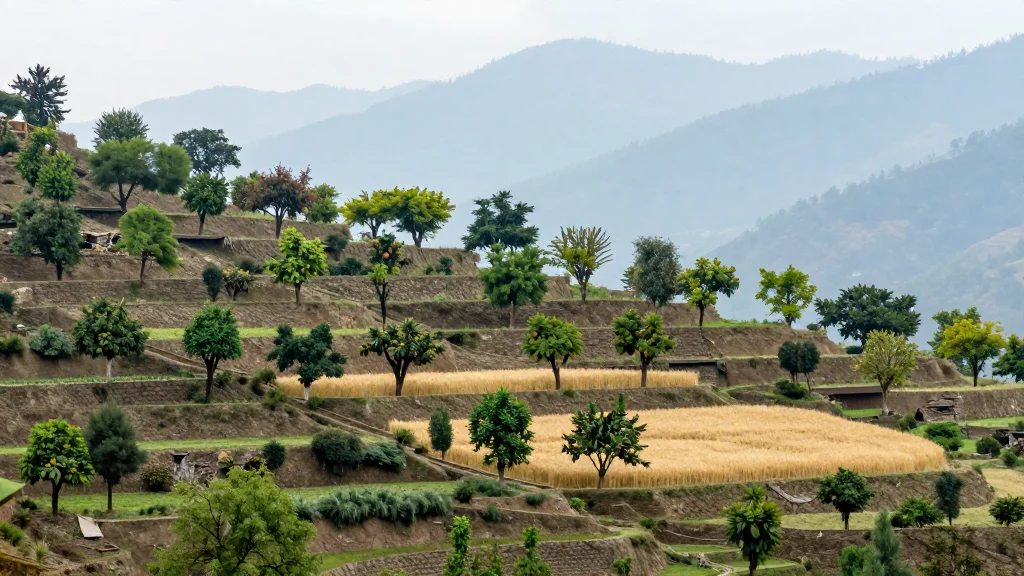
Altitude-Dependent Biomass Accumulation and Carbon Storage Potential of Agroforestry Systems in Garhwal Region, India
Why It Matters
The findings demonstrate that diversified agroforestry can substantially boost carbon sequestration in mountainous regions, offering a scalable strategy for climate mitigation and resilient land management in the Himalayas.
Key Takeaways
- •ASH home‑garden system achieved 162.7 t/ha biomass, 73.2 t C/ha
- •Biomass and carbon stocks rise with altitude up to 2300 m
- •Soil organic carbon remains largest carbon pool across systems
- •Diverse tree species boost sequestration more than altitude alone
- •Agroforestry can support climate‑resilient Himalayan land use
Pulse Analysis
Agroforestry has emerged as a frontline tool for climate change mitigation, especially in fragile mountain ecosystems where land‑use pressures and carbon emissions intersect. The Garhwal Himalaya, spanning elevations from 800 to 2,300 m, presents a natural laboratory to examine how altitude influences plant growth, decomposition rates, and overall carbon dynamics. By integrating trees with crops and horticulture, these systems can capture atmospheric CO₂ in both biomass and soils, while delivering livelihood benefits to local farmers. Understanding the altitude‑dependent performance of such models is crucial for designing region‑specific climate‑smart agriculture.
The recent field study surveyed 14 distinct agroforestry configurations, grouping them into agri‑silviculture, agri‑horticulture, and the more complex agri‑silvi‑horticulture (ASH) blends. Results showed that the ASH home‑garden model, designated HASH6, outperformed all others, achieving 162.7 t ha⁻¹ of total biomass and storing 73.2 t C ha⁻¹. Across the altitude gradient, both above‑ground and below‑ground biomass densities rose, reflecting cooler temperatures and slower organic matter turnover at higher elevations. Yet, soil organic carbon (SOC) remained the largest carbon reservoir, and its weak correlation with biomass suggests that soil processes operate semi‑independently of above‑ground growth, highlighting the need for targeted soil management practices.
Policy makers and development agencies can leverage these insights to prioritize diversified tree species mixes over simple altitude‑based site selection. Incentivizing ASH systems could accelerate carbon market participation, enhance rural incomes, and bolster ecosystem resilience against landslides and extreme weather. Moreover, the study underscores the importance of long‑term monitoring to untangle the complex interactions between climate, soil microbes, and plant diversity. As nations refine their Nationally Determined Contributions under the Paris Agreement, incorporating altitude‑aware agroforestry strategies offers a pragmatic pathway to meet both mitigation and adaptation goals in the Himalayan region.
Altitude-dependent Biomass accumulation and Carbon Storage Potential of Agroforestry Systems in Garhwal Region, India
Comments
Want to join the conversation?
Loading comments...