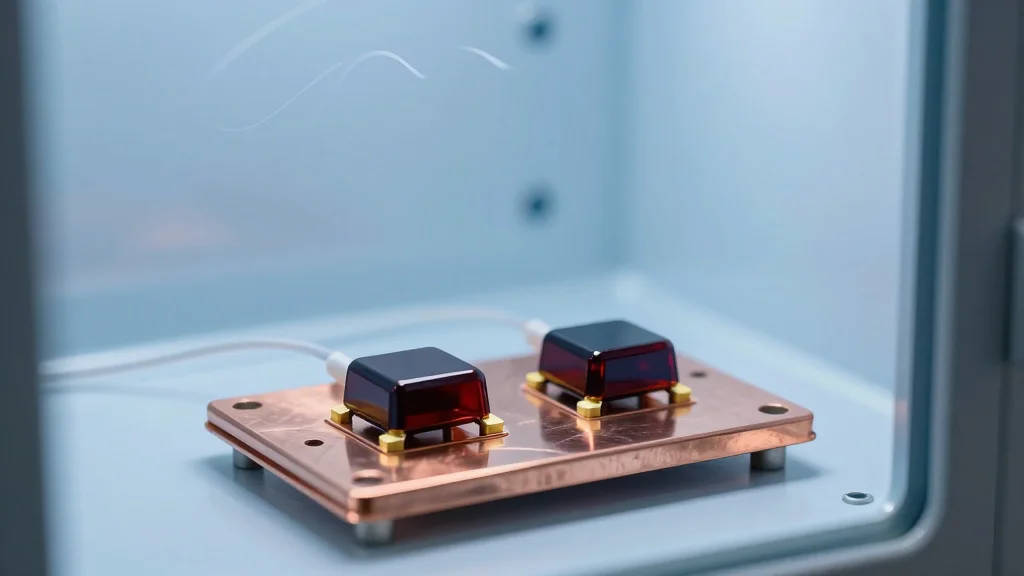
Amplifying Randomness with Quantum Measurements
Why It Matters
Certified quantum randomness removes reliance on unverifiable classical sources, raising cryptographic security to the physical limits. The scalable, hardware‑compatible design could accelerate deployment of truly unbreakable encryption across networks.
Key Takeaways
- •ETH Zurich generated 45 million certified random bits from 5 billion weak inputs
- •Loophole‑free Bell test performed over 30 m using transmon qubits
- •Device integrates randomness amplification on a single superconducting platform
- •Results enable cryptographic keys with physics‑level security
- •Approach leverages hardware already used in quantum computers
Pulse Analysis
The demand for truly unpredictable numbers has long outpaced the ability to prove their randomness. Classical generators—ranging from atmospheric noise to lava‑lamp photons—rely on complex physical assumptions that can never be fully verified. Quantum mechanics, by contrast, offers intrinsic indeterminacy, but translating that into a practical, certifiable source has been a technical hurdle. Recent advances in device‑independent protocols, especially randomness amplification, promise to bridge this gap, yet experimental constraints kept them theoretical for over a decade.
ETH Zurich’s team tackled the core challenges by marrying two well‑established quantum technologies: superconducting transmon qubits and a loophole‑free Bell test architecture. By cooling each qubit to millikelvin temperatures and linking them across a 30‑meter cryogenic channel, they ensured spacelike separation, preventing any hidden coordination. The upgraded hardware achieved both higher entanglement fidelity and faster data acquisition, allowing the researchers to process billions of weakly random bits and distill them into 45 million bits whose unpredictability is mathematically guaranteed by Bell‑inequality violations. Crucially, the entire workflow runs on a single integrated platform, eliminating the need for separate, trusted components.
The implications extend far beyond academic curiosity. Certified quantum randomness can underpin cryptographic key generation that is provably secure against any future computational attack, including those from quantum computers. Because the system uses transmon qubits—the same building blocks found in emerging quantum processors—it can be incorporated into existing quantum‑hardware supply chains, accelerating commercial adoption. Industries ranging from finance to defense stand to benefit from encryption that rests on the fundamental unpredictability of nature, heralding a new era of physical‑layer security for the digital economy.
Amplifying Randomness with Quantum Measurements
Comments
Want to join the conversation?
Loading comments...