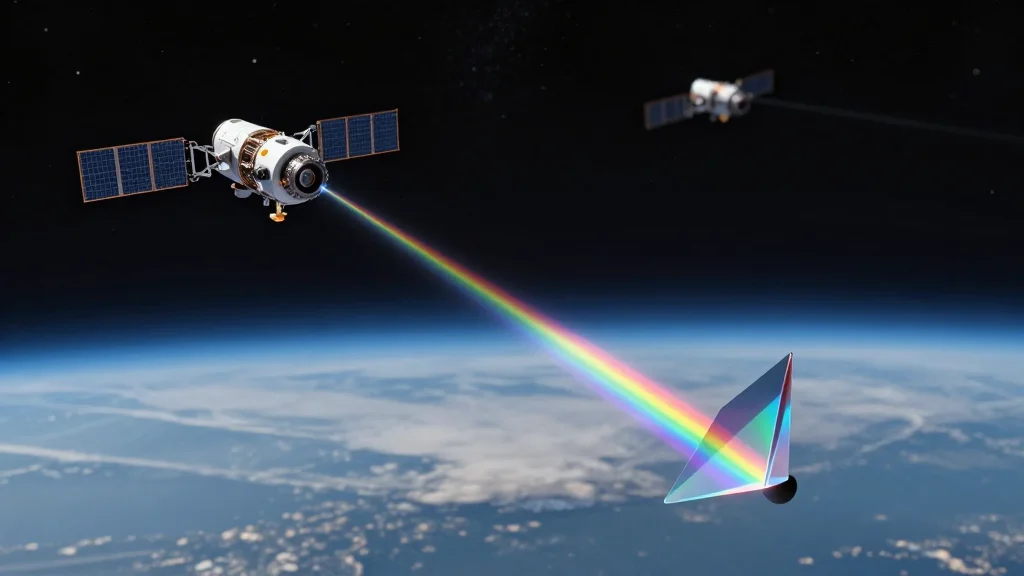
An Improved Method for Space-Based Gravitational-Wave Measurements
Why It Matters
By cutting noise and hardware complexity, the breakthrough lowers launch costs and improves sensitivity for future gravitational‑wave missions, accelerating the field’s scientific return.
Key Takeaways
- •New OFC‑based method syncs spacecraft clocks within 0.47 ns
- •Achieves noise reduction below LISA’s required detection threshold
- •Simplifies hardware for future space‑based interferometers
- •Enables precise ranging and navigation for multi‑craft missions
- •Provides path for improved time‑delay interferometry in next‑gen detectors
Pulse Analysis
Space‑based gravitational‑wave observatories like LISA fill a critical gap left by ground‑based detectors, targeting the millihertz band where supermassive black‑hole mergers emit. The core challenge lies in maintaining ultra‑stable laser links across millions of kilometers while compensating for fluctuating arm lengths and independent clock drifts. Time‑delay interferometry (TDI) has been the go‑to data‑processing solution, but its performance hinges on precise clock synchronization, a historically cumbersome hardware requirement.
The new scheme leverages an optical frequency comb (OFC) to lock each spacecraft’s clock directly to its laser carrier, turning two independent noise sources into a single, manageable signal. In laboratory simulations mimicking LISA’s laser links, the team achieved clock alignment better than 0.47 nanoseconds—well under the 3.3 ns benchmark—and demonstrated noise suppression sufficient for detecting faint spacetime ripples. By integrating clock and laser control, the architecture eliminates redundant components, promising lighter, cheaper payloads for follow‑on missions.
Beyond gravitational‑wave science, this advancement has broader ramifications for any multi‑craft formation requiring nanosecond‑level timing, such as deep‑space navigation, interferometric imaging, and precision geodesy. The ability to extract ranging and drift information from existing heterodyne signals could streamline future constellations, reducing development cycles and launch costs. As agencies plan successors to LISA, the OFC‑based TDI extension positions the industry to deliver more capable, cost‑effective observatories, potentially unlocking a new era of astrophysical discovery.
An Improved Method for Space-Based Gravitational-Wave Measurements
Comments
Want to join the conversation?
Loading comments...