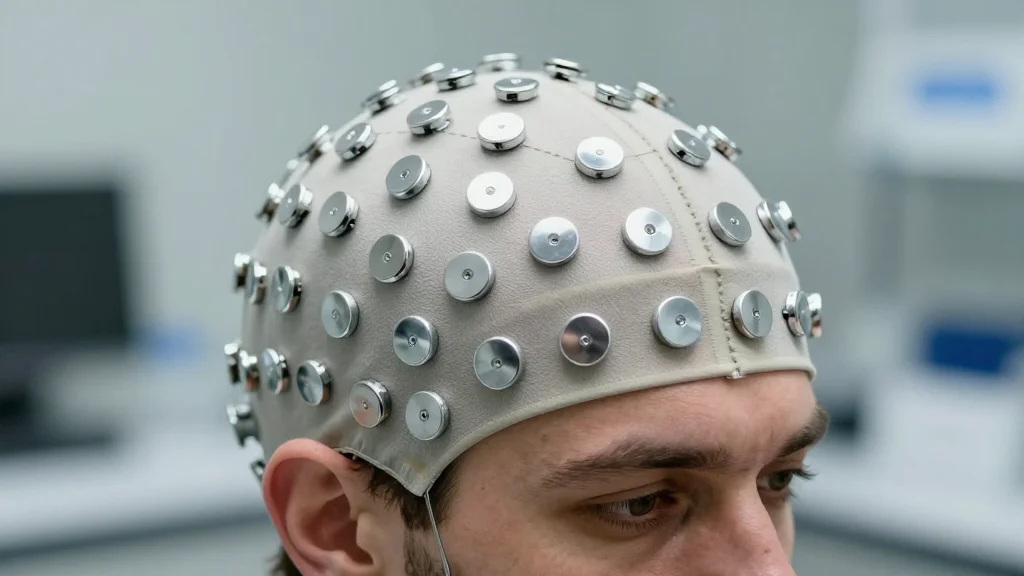
Analysis of Auditory Attention Based on Different Semantic Levels Using a Multi-Objective Coati Optimization Algorithm
Why It Matters
Optimizing EEG channel selection and leveraging semantic cues improves real‑time attention detection, accelerating brain‑computer interface development and clinical monitoring applications.
Key Takeaways
- •MOCOA selects EEG channels to reduce computational load.
- •Semantic-level classification outperforms generic models on PhyAAt data.
- •Voting classifiers improve accuracy across resting, writing, listening tasks.
- •Study introduces first optimization‑based channel selection for this dataset.
- •Findings support scalable brain‑computer interface applications.
Pulse Analysis
Auditory attention—our brain’s ability to focus on specific sounds while filtering out background noise—has become a cornerstone of neurotechnology research. Electroencephalography (EEG) offers a non‑invasive window into this cognitive process, capturing the rapid electrical fluctuations that underlie selective listening. Yet EEG’s high dimensionality and susceptibility to artifacts make real‑time classification a technical hurdle, especially when applications demand low latency, such as brain‑computer interfaces (BCIs) for assistive communication or adaptive hearing devices. Researchers therefore seek algorithms that can prune irrelevant channels without sacrificing the subtle patterns that indicate attention shifts.
The recent PhyAAt dataset, comprising recordings from 25 volunteers across resting, writing, and listening tasks under varied noise conditions, provides a rare testbed for semantic‑level analysis. Unlike prior work that treats auditory attention as a binary state, this study distinguishes native versus non‑native speech and different linguistic complexities. By deploying the Multi‑objective Coati Optimization Algorithm (MOCOA), the authors automatically selected the most informative EEG channels while balancing classification accuracy against computational cost. Coupled with ensemble voting classifiers, the approach consistently outperformed baseline models, confirming that semantic‑level features enhance detection even without channel reduction.
These results carry practical weight for next‑generation BCI systems and clinical monitoring tools. Efficient channel selection reduces hardware requirements, enabling wearable EEG headsets that can operate on limited power budgets while still delivering reliable attention metrics. Moreover, the demonstrated advantage of semantic‑level classification opens avenues for personalized auditory training, real‑time language comprehension aids, and early detection of attention‑related disorders such as ADHD. Future research will likely extend MOCOA to multimodal signals—combining EEG with heart rate or skin conductance—to further refine attention models and broaden their market impact.
Analysis of auditory attention based on different semantic levels using a Multi-objective Coati optimization algorithm
Comments
Want to join the conversation?
Loading comments...