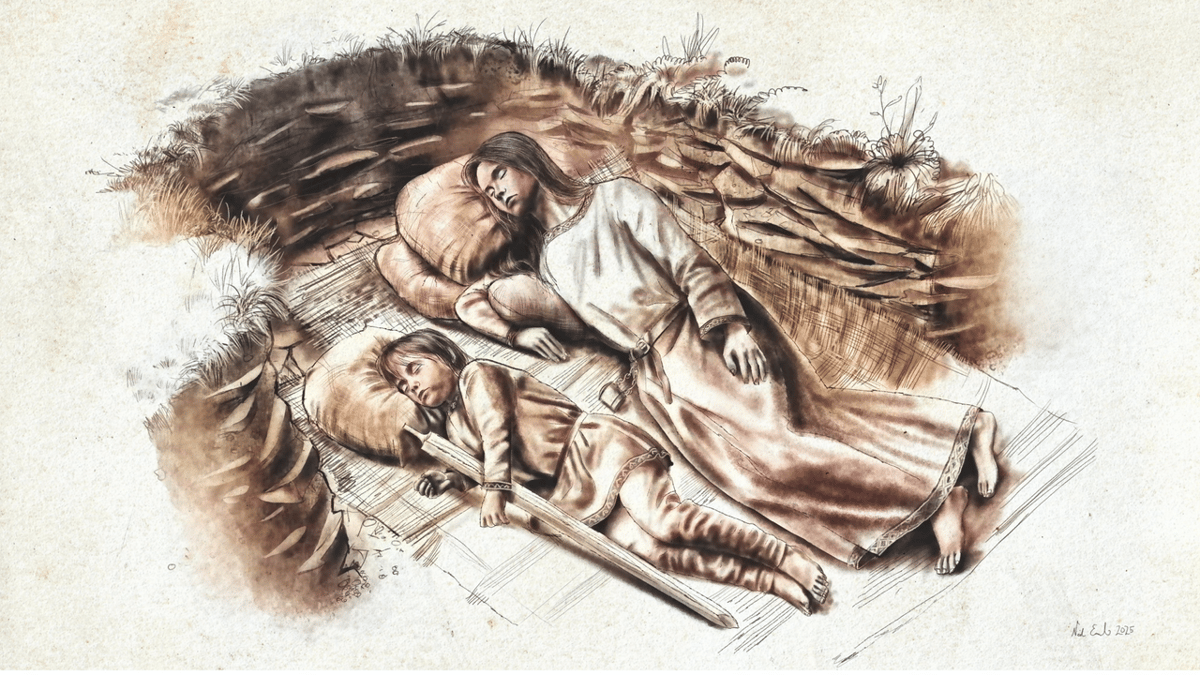
Anglo-Saxon Burial Holds an Older Sister Cradling Her Little Brother After They Both Died 1,400 Years Ago, Possibly of an Infectious Disease
Why It Matters
Identifying a sibling pair in an Anglo‑Saxon grave reshapes our understanding of household composition and disease impact in early medieval societies, informing both archaeological interpretation and historical epidemiology.
Key Takeaways
- •DNA confirms brother‑sister relationship in rare Anglo‑Saxon double burial.
- •Both children likely died simultaneously from a fast‑acting infection.
- •Sister positioned upright, suggesting caregiving role before death.
- •Findings highlight complex family networks in early medieval England.
- •Pathogen DNA may remain undetectable, limiting cause‑of‑death confirmation.
Pulse Analysis
The Cherington double burial adds a striking chapter to Anglo‑Saxon archaeology, where individual graves dominate the record and kinship links are seldom proven. By extracting ancient DNA from the skeletal remains, researchers at the Francis Crick Institute verified a brother‑sister relationship, confirming that the two children were interred together intentionally. Such genetic confirmation is rare for early medieval Europe, where burial customs often mask familial ties, making this find a valuable data point for scholars mapping social structures of the period.
Beyond the emotional narrative of a sister cradling her brother, the simultaneous death points to a fast‑acting infectious disease, a scenario that aligns with historical accounts of epidemic outbreaks in post‑Roman Britain. However, the absence of pathogen DNA in the remains underscores a methodological hurdle: many bacteria and viruses leave no trace in skeletal material, complicating efforts to pinpoint exact causes of death. Future advances in paleopathology and metagenomic sequencing may eventually reveal hidden microbial signatures, shedding light on health challenges faced by early medieval communities.
The broader implication of this discovery lies in its challenge to conventional views of Anglo‑Saxon households. While previous double burials have suggested adoption, fostering, or extended kin networks, the confirmed sibling pair illustrates that nuclear family loss was also a reality. This nuanced understanding enriches interpretations of social resilience, caregiving roles, and the emotional fabric of early medieval life. As more graves undergo DNA testing, archaeologists anticipate a clearer picture of family dynamics, disease transmission, and cultural practices that shaped the early English landscape.
Anglo-Saxon burial holds an older sister cradling her little brother after they both died 1,400 years ago, possibly of an infectious disease
Comments
Want to join the conversation?
Loading comments...