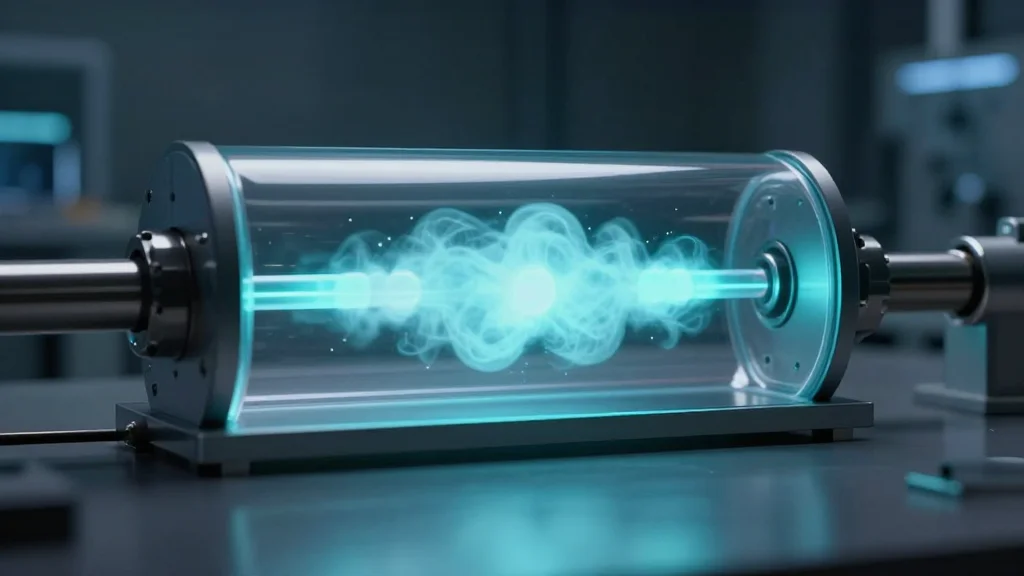
Antihydrogen Measurement Sharpens Antimatter Symmetry Test
Why It Matters
The result tightens constraints on possible CPT violations, reinforcing the Standard Model’s foundations, and opens a new window onto the antiproton’s sub‑structure. Such high‑precision antimatter spectroscopy informs both fundamental physics and future technologies that may exploit matter‑antimatter interactions.
Key Takeaways
- •Measurement improves antihydrogen hyperfine precision 100‑fold.
- •Result matches hydrogen within 4 ppm, confirming CPT symmetry.
- •Sensitivity now reaches antiproton internal‑structure effects.
- •24 000 antiatoms analyzed using enhanced magnetic trapping.
- •Future laser cooling could add another 100‑fold precision gain.
Pulse Analysis
Antihydrogen spectroscopy has become a cornerstone of modern fundamental‑physics research because it offers a direct comparison between matter and its mirror counterpart. The hyperfine splitting of hydrogen underpins the 21‑cm line used in astronomy, and measuring the same transition in antihydrogen tests the charge‑parity‑time (CPT) theorem that underlies the Standard Model. Prior to this work, antihydrogen hyperfine measurements were limited to parts‑per‑million precision, leaving a sizable gap between matter and antimatter data sets.
The ALPHA team’s breakthrough stems from a suite of technical refinements: higher trapping efficiencies now deliver about 1 500 antiatoms per experimental cycle, and a total of 24 000 atoms were interrogated across multiple runs. Enhanced magnetic‑field stability reduced line‑broadening, allowing the hyperfine frequency to be determined at 1 420 404.8 kHz with a 6 kHz uncertainty—four parts per million, an order of magnitude below the expected 40 ppm contribution from the antiproton’s internal charge distribution. This precision places the measurement squarely in a regime where the antiproton’s quark‑gluon structure begins to influence observable spectra.
Looking ahead, laser cooling of antihydrogen promises another two orders of magnitude improvement, potentially reaching sub‑ppm accuracy. Complementary approaches, such as the ASACUSA beam experiment, aim to sidestep magnetic‑trap systematic effects, further tightening CPT limits. If future data reveal even minute deviations, they could signal physics beyond the Standard Model, reshaping our understanding of symmetry breaking and informing the design of next‑generation antimatter technologies. The continued convergence of experimental ingenuity and theoretical insight ensures that antihydrogen will remain a pivotal probe of the universe’s most fundamental laws.
Antihydrogen Measurement Sharpens Antimatter Symmetry Test
Comments
Want to join the conversation?
Loading comments...