April 17, 2026 Quick Space Links
Companies Mentioned
Why It Matters
NASA’s backing speeds Europe’s first Mars sample‑return rover, deepening U.S.–European space ties, while the Apollo 8 book rekindles public fascination with historic lunar missions and the Orion footage highlights the enduring pursuit of breakthrough propulsion.
Key Takeaways
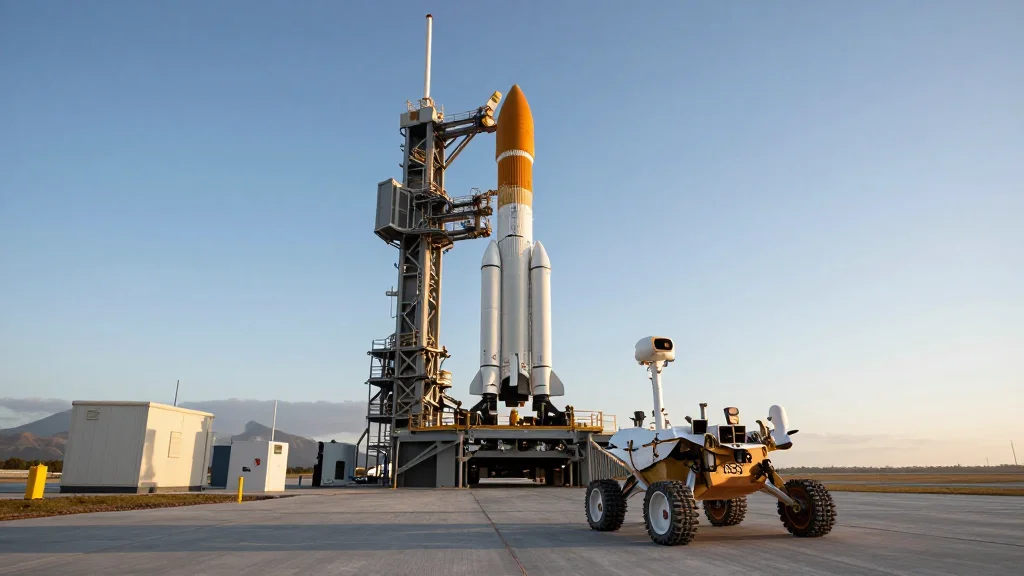
- •NASA will buy Falcon Heavy for ESA's 2028 Rosalind Franklin launch
- •Airbus and Sener tasked with building rover lander after Russia's exit
- •1959 Project Orion test video shows chemical explosives as thrust precursor
- •"Genesis: the Story of Apollo 8" released as ebook, audiobook, hardback
Pulse Analysis
NASA’s decision to supply a Falcon Heavy, landing engines, and radioisotope heater units to ESA marks a pivotal moment for the Rosalind Franklin Mars rover, the first European mission designed to retrieve and return Martian samples. By securing a proven heavy‑lift vehicle, the partnership mitigates launch risk and aligns the 2028 timeline with broader Artemis and Mars exploration objectives. Airbus and Sener’s involvement in the lander underscores Europe’s growing industrial capability, especially after Russia’s exclusion following the 2022 Ukraine invasion, reinforcing a more resilient supply chain.
The newly surfaced 1959 Project Orion test video offers a rare glimpse into early propulsion experiments that used chemical explosives to generate thrust. Although Orion’s ultimate vision—propelling a spacecraft with a series of nuclear detonations—remains unrealized, the footage illustrates the iterative nature of high‑energy propulsion research. Modern concepts such as nuclear thermal rockets and pulsed‑fusion drives draw intellectual lineage from these Cold‑War era studies, reminding policymakers that breakthrough propulsion often emerges from decades‑long experimentation.
Robert Zimmerman’s "Genesis: the Story of Apollo 8" adds cultural depth to the technical discourse, presenting the first human journey beyond Earth’s orbit in both ebook ($5.99) and audiobook formats, with hardback and paperback editions priced at $60 and $45 respectively. The release, complete with a foreword by Valerie Anders, serves educators, historians, and space enthusiasts seeking a comprehensive narrative of the 1968 mission. By making the story accessible across multiple platforms, the book helps preserve the legacy of Apollo 8 and fuels renewed interest in lunar and deep‑space exploration initiatives.
April 17, 2026 Quick space links
Comments
Want to join the conversation?
Loading comments...