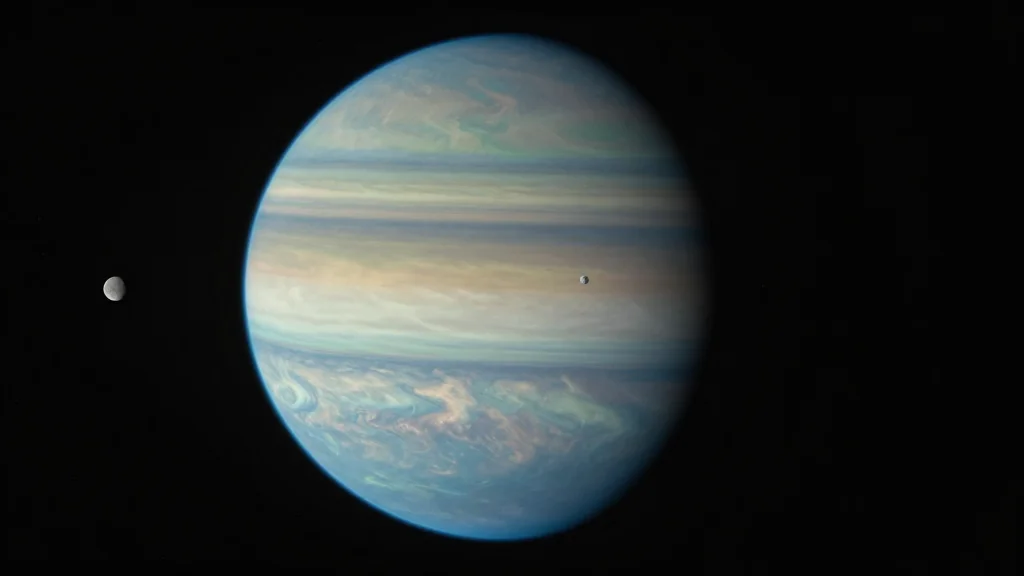
April 30, 1998: The Discovery of Caliban and Sycorax
Why It Matters
The find expanded knowledge of Uranus’s satellite system and highlighted planetary capture processes, influencing models of outer‑solar‑system dynamics.
Key Takeaways
- •First irregular moons discovered orbiting Uranus.
- •Sycorax measures ~120 km; Caliban ~60 km in diameter.
- •Both exhibit low albedo and reddish coloration.
- •Orbits: 3.5 years (Sycorax) vs 1.6 years (Caliban).
- •Likely captured Centaurs or trans‑Neptunian objects.
Pulse Analysis
The 1998 Nature paper that unveiled Uranus’s moons Sycorax and Caliban marked a milestone in outer‑planet astronomy. Detected on September 6, 1997 with the 200‑inch Hale Telescope at Palomar, the faint objects pushed the limits of ground‑based imaging, revealing satellites as small as 60 km across. Their discovery came at a time when only regular, close‑orbit moons were known around Uranus, prompting a reassessment of the planet’s satellite inventory and the observational techniques needed to spot distant, dim bodies.
Both moons share hallmark traits of irregular satellites: highly inclined, eccentric orbits and surfaces that reflect little sunlight. Sycorax, roughly twice the size of Caliban, circles Uranus every 3.5 years, while Caliban completes an orbit in 1.6 years. Their reddish hue and extremely low albedo point to composition similar to Centaurs and trans‑Neptunian objects, supporting the hypothesis that they were captured by Uranus’s gravity rather than forming in situ. This capture scenario aligns with models of planetary migration that predict the exchange of small bodies among the giant planets.
The implications extend beyond Uranus. Captured irregular moons serve as natural probes of the early solar system, preserving material from the distant Kuiper Belt. Understanding their origins refines dynamical simulations of how giant planets acquire and lose satellites, informing the design of future missions such as the proposed Uranus orbiter‑probe. Moreover, the successful detection of such faint objects underscores the value of large‑aperture telescopes and advanced image‑processing, techniques that will be crucial for discovering even smaller moons around other distant planets.
April 30, 1998: The discovery of Caliban and Sycorax
Comments
Want to join the conversation?
Loading comments...