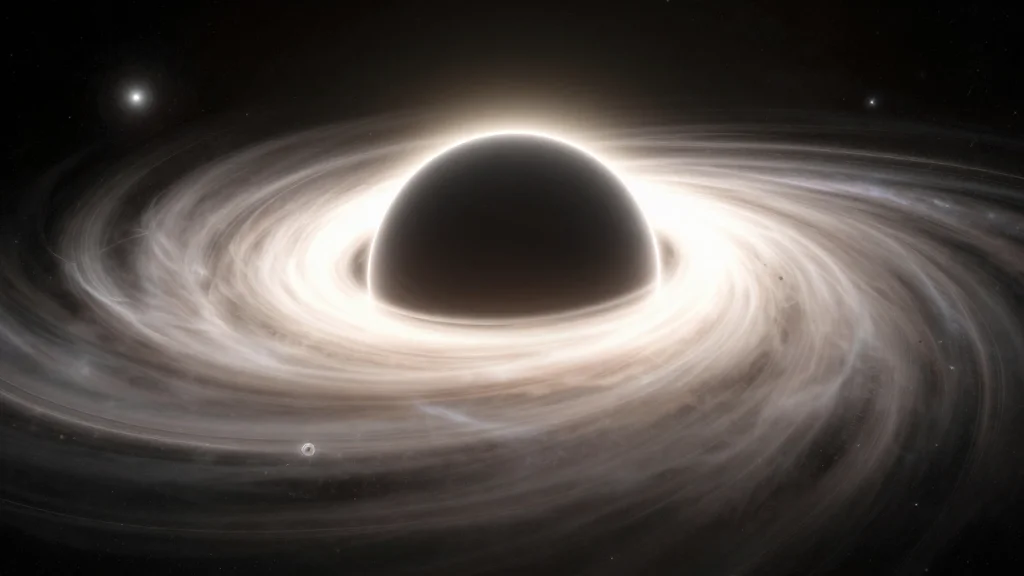
Are JWST's Early, Overmassive Black Holes Just Normal-Range Outliers?
Why It Matters
If early SMBHs are not anomalously massive, standard stellar‑remnant seed models suffice, simplifying cosmological simulations and informing JWST survey design.
Key Takeaways
- •JWST's early SMBH detections suffer from luminosity selection bias.
- •Stacking ~2,000 galaxies shows BH masses align with local relation.
- •Median early‑universe BHs are at most 10× overmassive.
- •Light stellar‑remnant seeds with moderate Eddington accretion suffice.
- •Heavy‑seed hypothesis becomes unnecessary after bias correction.
Pulse Analysis
JWST’s unprecedented infrared vision has revealed a surprising population of supermassive black holes at redshifts beyond three, sparking debate over how such giants could form within the universe’s first two billion years. Early interpretations leaned on the "heavy‑seed" hypothesis, proposing that massive black‑hole progenitors—perhaps direct‑collapse gas clouds—seeded the observed behemoths. This narrative reshaped theoretical models and motivated a wave of high‑redshift surveys aimed at catching these cosmic monsters in the act.
A recent paper in The Astrophysical Journal takes a different tack by aggregating spectra from roughly 2,000 galaxies observed in JWST’s CEERS, JADES, RUBIES and GLASS deep‑field programs. Using a stacking technique, the researchers average faint signals to overcome the noise that plagues individual detections. Their analysis shows that, once the luminosity bias of bright active galactic nuclei is removed, the majority of early‑universe black holes sit near the local black‑hole‑to‑stellar‑mass relation, with typical over‑mass factors no larger than ten. This finding suggests that the previously reported 10‑100× discrepancies were statistical outliers rather than a new population.
The implications ripple through astrophysics. If most early black holes grew from light stellar‑remnant seeds at moderate Eddington rates, cosmological simulations can revert to simpler growth prescriptions, reducing reliance on exotic formation channels. Moreover, future JWST programs may prioritize deeper, wider surveys that capture the fainter AGN tail, ensuring a more representative census of black‑hole activity at cosmic dawn. The study thus refines our picture of black‑hole evolution and underscores the importance of accounting for observational bias in high‑redshift astronomy.
Are JWST's early, overmassive black holes just normal-range outliers?
Comments
Want to join the conversation?
Loading comments...