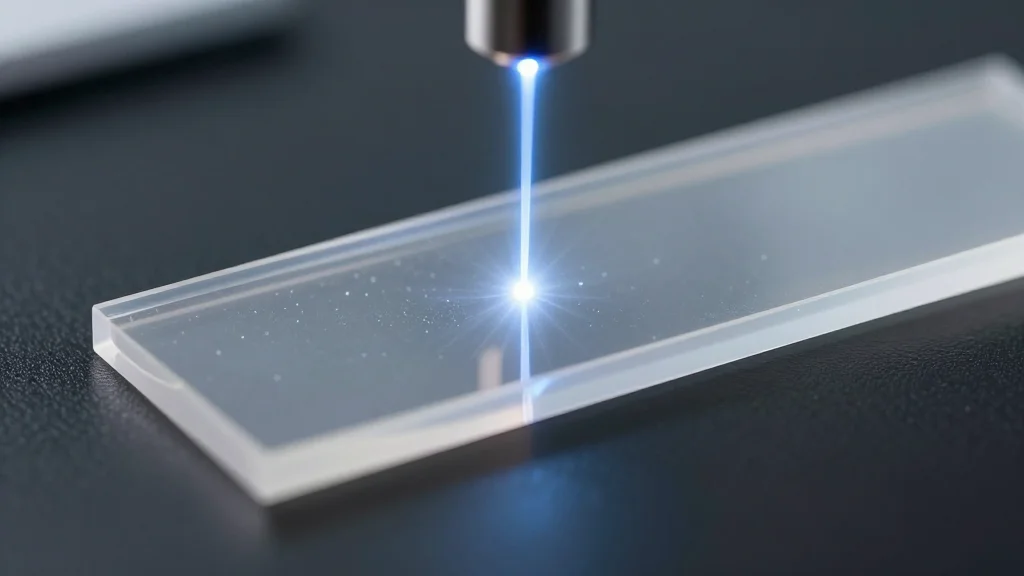
Argonne Researchers Trigger Higgs‑Mode Symmetry Shift in Perovskite Crystals with Ultrafast Light

Why It Matters
The ability to manipulate crystal symmetry with light challenges the long‑standing reliance on temperature or chemical doping to access new material phases. In the fast‑growing field of perovskite optoelectronics, where efficiency and stability are paramount, a non‑thermal knob could dramatically accelerate device optimization. Beyond practical applications, the observation of a Higgs mode in a semiconductor bridges concepts from high‑energy physics to solid‑state systems, offering a tangible platform to study symmetry‑breaking dynamics that were previously confined to abstract theory. Furthermore, the technique showcases how ultrafast spectroscopy can serve not just as a diagnostic tool but as an active means of engineering material properties. As researchers aim to build quantum computers and ultra‑high‑speed photonic circuits, the capacity to toggle between distinct electronic states on femtosecond timescales could become a cornerstone of future technology stacks.
Key Takeaways
- •Argonne scientists used femtosecond laser pulses to excite a Higgs‑like mode in a 2D metal‑halide perovskite.
- •The Higgs mode drives the crystal into a higher‑symmetry phase unattainable by heating alone.
- •This is the first reported Higgs mode in a semiconductor material.
- •Light‑induced symmetry changes could enable ultrafast, reconfigurable optoelectronic devices.
- •Future work will explore pulse‑parameter tuning and integration into prototype devices.
Pulse Analysis
The discovery marks a paradigm shift in how condensed‑matter physicists approach phase control. Historically, researchers have relied on static parameters—temperature, pressure, or chemical composition—to navigate a material’s phase space. The Argonne experiment demonstrates that coherent light can act as a dynamic, reversible control knob, effectively reshaping the potential energy landscape on femtosecond timescales. This capability aligns with the broader trend of ‘photonic engineering’ where light is not merely a probe but a catalyst for material transformation.
From a market perspective, perovskite photovoltaics have already attracted billions of dollars in venture funding due to their high efficiencies and low‑cost fabrication. However, stability and reproducibility remain hurdles. By offering a method to transiently access higher‑symmetry phases with superior electronic properties, ultrafast light control could accelerate the commercialization timeline, especially for applications that demand rapid switching, such as optical modulators and quantum bits. Companies investing in perovskite‑based photonics may soon explore integrating femtosecond pulse generators into their device architectures, creating a niche for ultrafast laser technology providers.
Looking forward, the broader scientific community is likely to replicate the approach across other quantum materials—charge‑density‑wave systems, topological insulators, and unconventional superconductors—to test whether Higgs‑mode activation is a universal pathway to hidden phases. If the technique proves scalable, it could redefine material discovery pipelines, shifting emphasis from static synthesis to dynamic, light‑driven exploration. The convergence of ultrafast optics, materials science, and quantum technology thus stands poised to unlock a new frontier of functional materials.
Argonne Researchers Trigger Higgs‑Mode Symmetry Shift in Perovskite Crystals with Ultrafast Light
Comments
Want to join the conversation?
Loading comments...