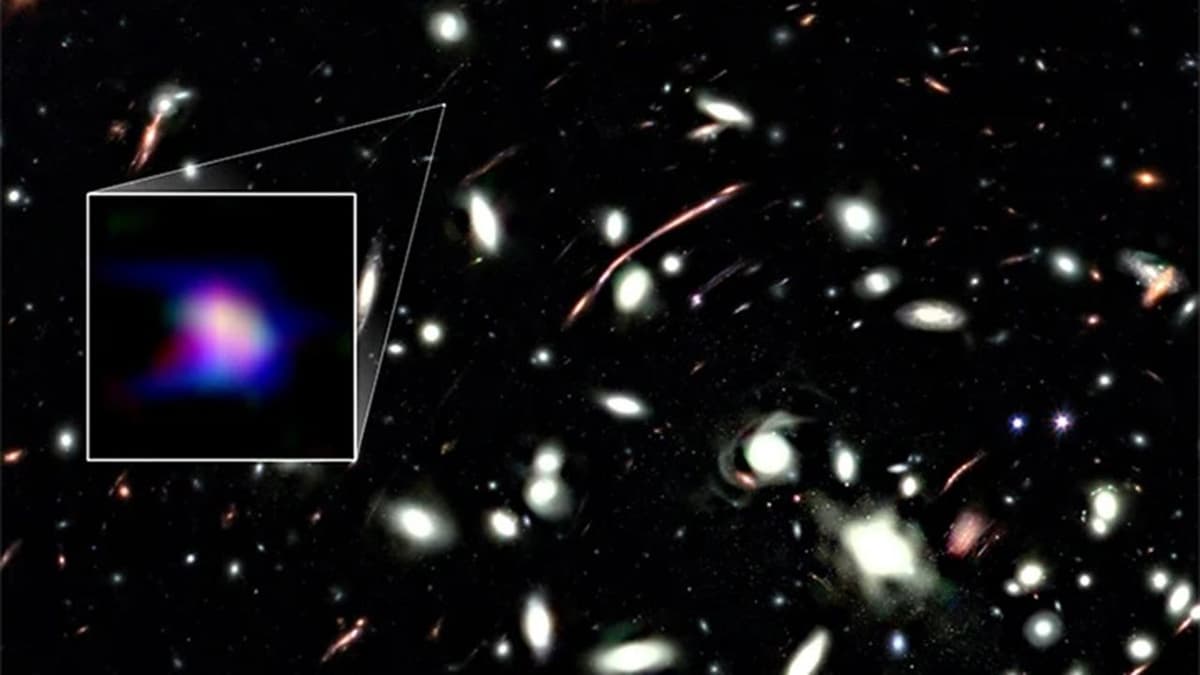
'Astonishing': James Webb Telescope Spots the Most Chemically Primitive Galaxy in the Ancient Universe
Why It Matters
The discovery provides the first concrete chemical snapshot of a primordial galaxy, bridging the gap between theoretical Population III star models and observable fossil galaxies. It reshapes our understanding of early element formation and the evolutionary pathways of the smallest galactic structures.
Key Takeaways
- •JWST identified galaxy LAP1‑B 800 million years after Big Bang
- •LAP1‑B shows oxygen abundance 1/240 of the Sun
- •Carbon‑to‑oxygen ratio matches predictions for Population III supernova remnants
- •Gravitational lens magnified galaxy light ~100×, enabling 30‑hour spectroscopy
- •Findings link ultra‑faint dwarf galaxies to early Universe progenitors
Pulse Analysis
The James Webb Space Telescope has finally opened a window onto the universe’s darkest ages, allowing scientists to probe galaxies that formed during the Epoch of Reionization. By capturing infrared light that has been stretched beyond the reach of older observatories, JWST can dissect the chemical fingerprints of objects that existed less than a billion years after the Big Bang. This capability is crucial for testing models of early star formation and the transition from a pristine, hydrogen‑helium cosmos to one enriched with heavier elements.
In a landmark study, an international team led by Kimihiko Nakajima used JWST’s spectrometers together with a massive galaxy cluster acting as a gravitational lens to magnify LAP1‑B by about 100 times. After 30 hours of deep exposure, the spectrum revealed an oxygen abundance merely 0.4% of solar levels and a carbon‑to‑oxygen ratio that mirrors the expected yields of the first, massive Population III stars. The galaxy’s minuscule stellar mass—under 3,300 solar masses—implies a dominant dark‑matter halo, matching the profile of ultra‑faint dwarf galaxies that orbit the Milky Way today.
The implications extend far beyond a single object. By confirming that such chemically primitive galaxies existed and could be observed directly, astronomers now have a tangible benchmark for the earliest phases of chemical enrichment. This breakthrough paves the way for systematic searches for even older, more metal‑free systems, refining our picture of how the elements that compose life were forged. As JWST continues to survey the distant universe, the link between primordial starbursts and modern galactic fossils will become a cornerstone of cosmological theory.
'Astonishing': James Webb telescope spots the most chemically primitive galaxy in the ancient universe
Comments
Want to join the conversation?
Loading comments...