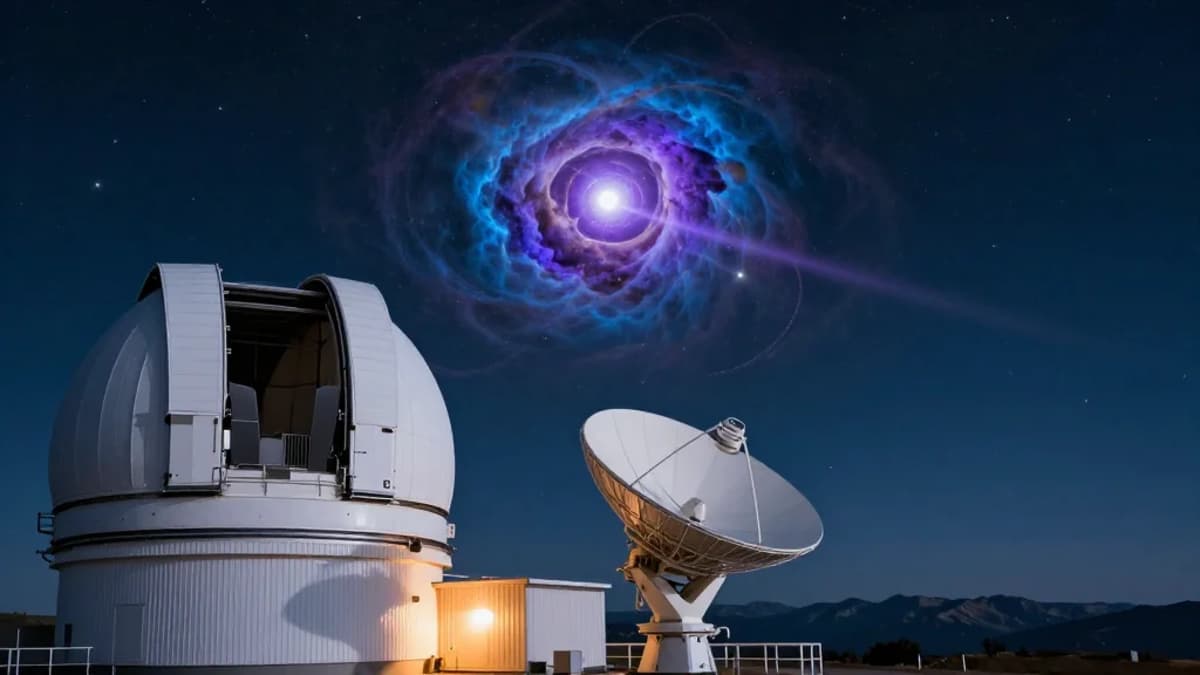
Astronomers Capture Birth of a Magnetar, Confirming Link to Some of Universe’s Brightest Exploding Stars
•March 11, 2026
0
Why It Matters
The observation validates theories that magnetars power superluminous supernovae and gamma‑ray bursts, reshaping our understanding of stellar death and high‑energy astrophysics. It also creates a natural laboratory for studying extreme magnetic fields and relativistic physics.
Key Takeaways
- •Magnetar formed from massive star collapse observed directly
- •X-ray flash lasted 0.2 seconds, 10^46 ergs released
- •Link established between magnetars and superluminous supernovae
- •Data from NASA's NICER and Swift telescopes
- •Findings refine models of neutron star magnetic field generation
Pulse Analysis
The birth of a magnetar—an ultra‑magnetized neutron star—has long been a missing piece in high‑energy astrophysics. Magnetars possess magnetic fields a thousand trillion times stronger than Earth’s, and theory predicts they can inject vast amounts of energy into surrounding ejecta. By capturing the moment of formation, researchers have confirmed that the rapid spin‑down of a newborn magnetar can convert rotational energy into the luminous output observed in superluminous supernovae and certain gamma‑ray bursts, bridging a gap that has persisted for decades.
The detection relied on coordinated observations from NASA's NICER X‑ray timing instrument aboard the International Space Station and the Swift satellite’s Burst Alert Telescope. Within 0.2 seconds, the telescopes recorded an X‑ray flash delivering about 10^46 ergs—equivalent to the Sun’s total output over ten million years. Follow‑up spectroscopy revealed a rapidly rotating core with a magnetic field exceeding 10^15 gauss, matching the theoretical profile of a nascent magnetar. These metrics not only confirm the energy budget required for the brightest stellar explosions but also provide a benchmark for future transient surveys.
Beyond confirming a key astrophysical mechanism, the finding has ripple effects across related fields. It sharpens predictive models used to interpret data from upcoming observatories like the Vera C. Rubin Observatory and the European Athena X‑ray mission. Moreover, understanding magnetar-driven explosions informs the search for gravitational‑wave signatures associated with extreme stellar collapse. As the community integrates this real‑time data, the episode marks a turning point in decoding the most energetic events the cosmos can produce.
Astronomers Capture Birth of a Magnetar, Confirming Link to Some of Universe’s Brightest Exploding Stars
0
Comments
Want to join the conversation?
Loading comments...