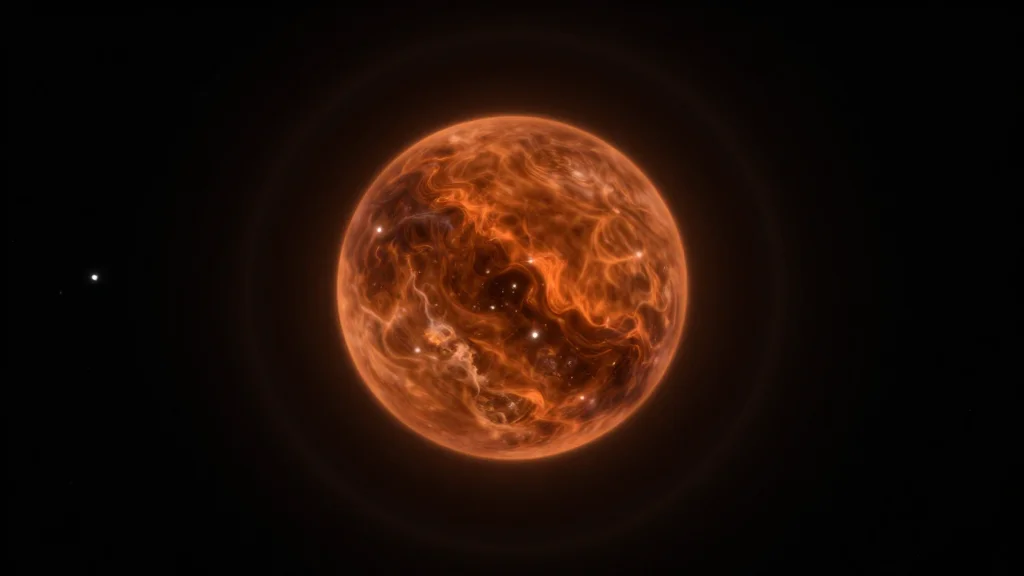
Astronomers Determine Brown Dwarf Age Using Tiny Stellar Pulsations
Why It Matters
Accurately dating brown dwarfs sharpens our understanding of sub‑stellar cooling and formation timelines, informing both theoretical models and exoplanet surveys. The technique opens a pathway to age‑determine isolated brown dwarfs lacking stellar companions.
Key Takeaways
- •Brown dwarf HR 7672 B age estimated at 2.5 billion years
- •Asteroseismology detected pulsations under a few ppm
- •Method refines sub‑stellar cooling‑rate models
- •Can date isolated brown dwarfs without host stars
- •Results published in Astrophysical Journal Letters
Pulse Analysis
The breakthrough hinges on asteroseismology, a technique traditionally reserved for Sun‑like stars, where minute brightness variations reveal internal structures. By adapting ultra‑high‑precision photometry to the faint glow of HR 7672 B, researchers captured pulsations as small as a few parts per million. These oscillations encode the object's density and temperature profile, which, when fed into evolutionary models, yield a precise age estimate. This cross‑disciplinary approach bridges stellar physics and sub‑stellar astronomy, expanding the toolkit for probing objects at the boundary between stars and planets.
Brown dwarfs occupy a gray zone in astrophysics, cooling and dimming over time without sustained nuclear fusion. Until now, age estimates relied heavily on indirect methods such as kinematic membership or association with a primary star. The new pulsation‑based measurement provides a direct chronometer, reducing uncertainties that have plagued mass‑luminosity relationships. With a reliable age for HR 7672 B, theorists can calibrate cooling curves more accurately, improving predictions for the population of free‑floating brown dwarfs detected in deep sky surveys.
The implications extend beyond academic curiosity. Precise brown‑dwarf ages help refine the search for exoplanets, as many detection techniques—like direct imaging—target young, luminous sub‑stellar companions. Knowing how quickly brown dwarfs fade informs target selection and observation strategies for next‑generation telescopes such as the James Webb Space Telescope and the upcoming Nancy Grace Roman Space Telescope. Moreover, the method could be applied to a broader sample of isolated brown dwarfs, potentially reshaping our census of the Galaxy’s low‑mass constituents.
Astronomers Determine Brown Dwarf Age Using Tiny Stellar Pulsations
Comments
Want to join the conversation?
Loading comments...