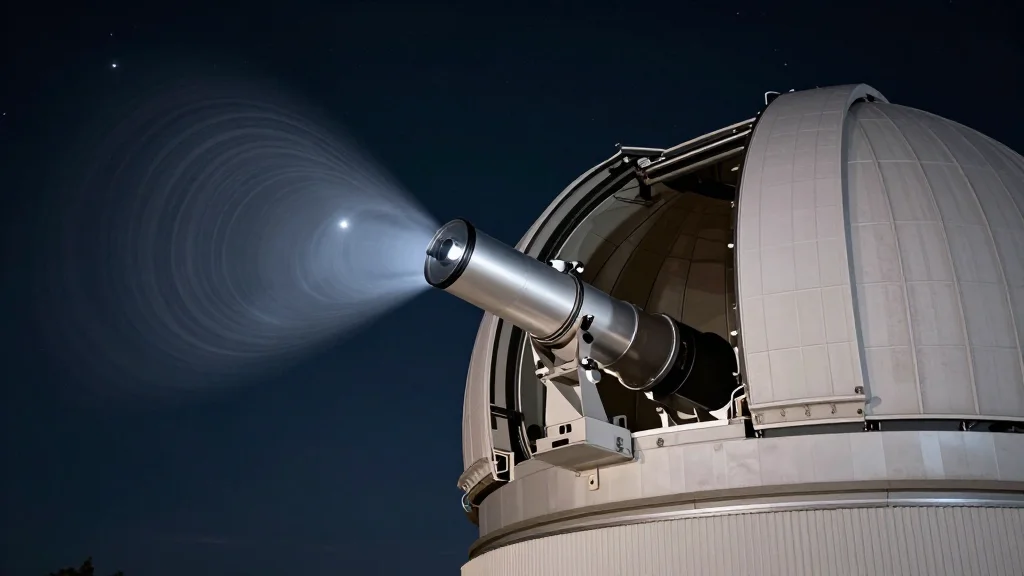
Astronomers Directly Detect How Turbulence Between Stars Distorts Light
Why It Matters
Understanding interstellar turbulence sharpens distance measurements and improves the reliability of exoplanet and cosmological observations, directly impacting precision astronomy.
Key Takeaways
- •First direct measurement of interstellar turbulence affecting starlight.
- •Researchers used high‑resolution spectroscopy from the Harvard‑Smithsonian Center.
- •Findings refine models of the interstellar medium’s density fluctuations.
- •Improves accuracy of distance estimates and exoplanet transit observations.
Pulse Analysis
Interstellar turbulence has long been a hidden variable in astronomical measurements, influencing everything from stellar brightness to the apparent positions of distant objects. Traditionally, scientists inferred its presence indirectly through statistical analyses of radio scintillation or by modeling dust extinction. Those methods, while useful, left a gap in confirming how exactly turbulent eddies distort light on a star‑by‑star basis. The new detection closes that gap, offering a concrete observational anchor for theories that describe the chaotic motions of ionized gas across the Milky Way.
The breakthrough came from a collaboration at the Harvard‑Smithsonian Center for Astrophysics, which leveraged ultra‑stable spectrographs capable of resolving velocity changes of just a few centimeters per second. By monitoring a set of bright, well‑characterized stars over several months, the researchers captured subtle, time‑varying shifts in spectral lines that matched predictions of light scattering by turbulent plasma. This direct measurement validates computational models of the interstellar medium’s power spectrum and provides a quantitative metric for the strength and scale of turbulence along specific sightlines.
Beyond satisfying a long‑standing scientific curiosity, the findings have practical ramifications for high‑precision astronomy. Accurate distance ladders, exoplanet transit timing, and even gravitational wave localization depend on clean, undistorted light signals. Incorporating turbulence corrections can reduce systematic errors, enhancing the fidelity of next‑generation surveys such as the Vera C. Rubin Observatory and the James Webb Space Telescope. As researchers refine these techniques, the ability to map turbulence across the galaxy will become a standard component of astrophysical data pipelines, sharpening our view of the cosmos.
Astronomers Directly Detect How Turbulence Between Stars Distorts Light
Comments
Want to join the conversation?
Loading comments...