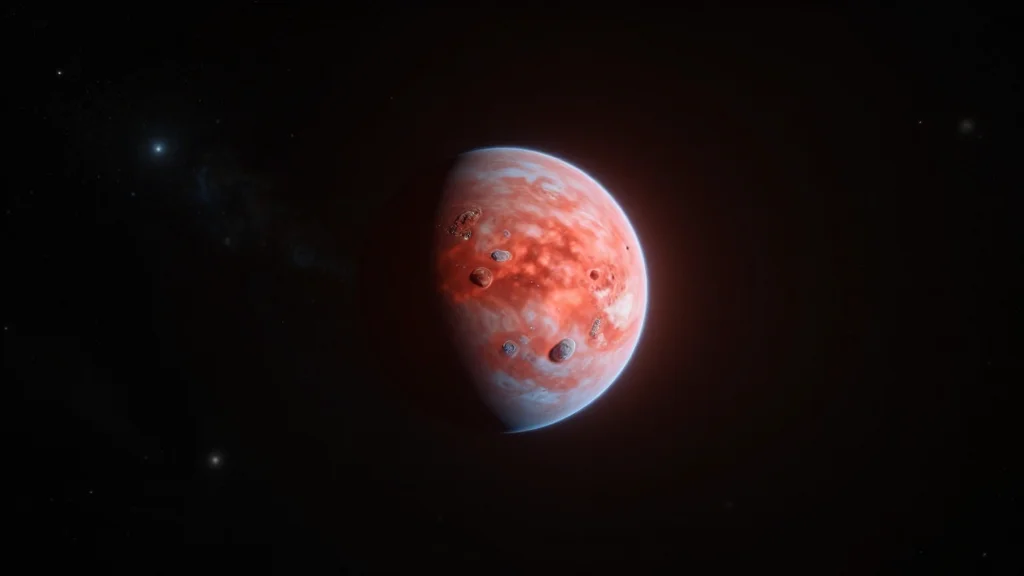
Astronomers Discover a Super-Earth Orbiting a Nearby Red Dwarf
Why It Matters
Ross 318 b offers a rare, nearby super‑Earth in the habitable zone, opening a practical pathway for detailed atmospheric characterization and advancing the search for potentially life‑supporting worlds. The multi‑instrument approach sets a new standard for overcoming stellar activity noise in exoplanet detection.
Key Takeaways
- •Ross 318 b orbits every 39.63 days at 0.16 AU
- •Minimum mass 6.21 Earth masses, radius ~1.74 Earth radii
- •Located 28 light‑years away, within the conservative habitable zone
- •Combined CARMENES, HIRES, and TESS data to overcome stellar activity
- •Potential atmosphere could enable JWST transmission spectroscopy
Pulse Analysis
The discovery of Ross 318 b underscores the growing importance of red dwarf systems in exoplanet science. M‑type stars, which comprise roughly 75% of the Milky Way’s stellar population, are prime hunting grounds for small, rocky planets because their low luminosity brings the habitable zone close to the star. However, intense magnetic activity and starspots have historically hampered radial‑velocity measurements, leading to false signals or missed detections. By integrating long‑baseline spectroscopic data from CARMENES and HIRES with high‑precision TESS photometry, the research team demonstrated how complementary datasets can disentangle planetary signals from stellar noise, a technique likely to become standard as surveys target ever more active stars.
Ross 318 b’s physical characteristics make it especially compelling. With a minimum mass of 6.21 M⊕ and an estimated radius of 1.74 R⊕, the planet sits at the boundary between rocky super‑Earths and mini‑Neptunes, suggesting it could retain a substantial atmosphere. Its equilibrium temperature of about 237 K places it comfortably within the conservative habitable zone, despite being tidally locked. Atmospheric circulation models predict that a thick atmosphere could redistribute heat efficiently, mitigating the extreme day‑night temperature contrast typical of close‑in, tidally locked worlds. These attributes position Ross 318 b as a top candidate for transmission spectroscopy with the James Webb Space Telescope, where researchers hope to detect molecular signatures such as water vapor, carbon dioxide, or methane.
Beyond the individual planet, the methodological breakthrough has broader implications for the exoplanet field. The successful mitigation of spot‑induced aliases through combined RV and photometric analysis paves the way for systematic surveys of active M‑dwarfs, expanding the catalog of potentially habitable worlds. As next‑generation instruments like the Extremely Large Telescope and the Nancy Grace Roman Space Telescope come online, the template established by the Ross 318 b team will enable more efficient identification and characterization of temperate super‑Earths, accelerating the quest to answer whether life exists beyond our solar system.
Astronomers discover a super-Earth orbiting a nearby red dwarf
Comments
Want to join the conversation?
Loading comments...