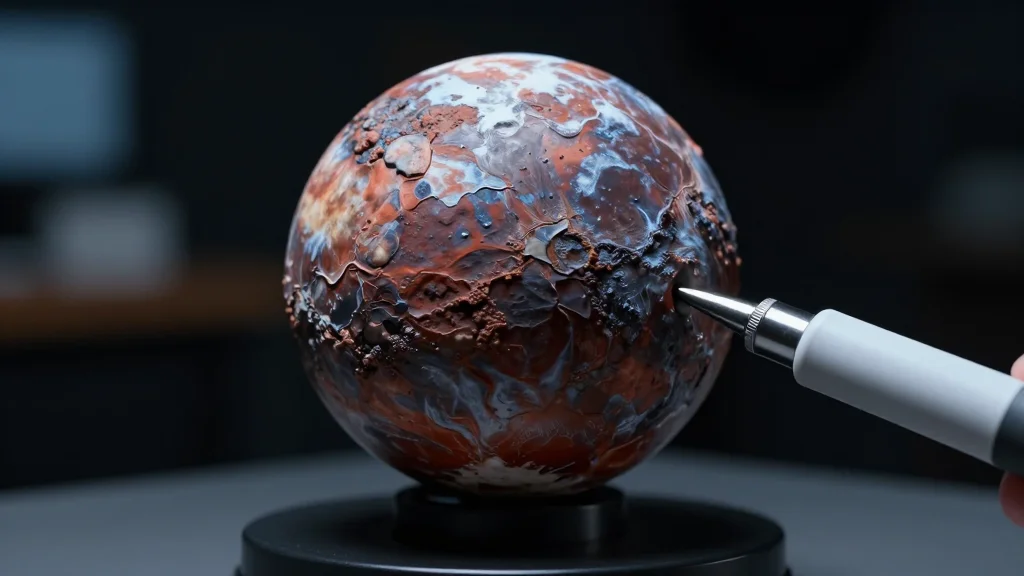
Astronomers Explore the Surface Composition of a Nearby Super-Earth
Why It Matters
This breakthrough provides the first empirical evidence of planetary geology beyond the Solar System, informing models of planet formation and atmospheric erosion, and it guides target selection for future missions seeking habitable worlds.
Key Takeaways
- •JWST detected silicate signatures on a 1.3 R⊕ super‑Earth
- •Planet orbits a red dwarf 48 light‑years away
- •Surface temperature estimated at ~1,000 K, too hot for liquid water
- •Findings suggest rocky composition similar to Mercury
- •Study refines models for atmospheric loss on close‑in exoplanets
Pulse Analysis
The hunt for Earth‑like worlds has accelerated since the launch of the James Webb Space Telescope, yet probing the solid surfaces of distant planets remains a formidable challenge. Super‑Earths—planets with masses between Earth and Neptune—are abundant in the galaxy, but their bulk composition has largely been inferred from mass‑radius relationships. Direct spectroscopic measurements of surface materials were considered out of reach until JWST’s unprecedented infrared sensitivity allowed astronomers to isolate the faint glow of a planet’s dayside from its host star’s glare.
In the latest study, researchers targeted LHS 3844b, a 1.3 R⊕ planet circling a quiet M‑dwarf 48 light‑years away. By collecting high‑resolution spectra during secondary eclipses, the team identified absorption features that match laboratory signatures of basaltic rock and iron‑rich minerals. The inferred surface temperature of roughly 1,000 K confirms an airless, molten‑rock environment, akin to Mercury’s barren landscape. These observations also illuminate how intense stellar radiation strips volatile atmospheres, leaving behind a bare, rocky core—a process critical to understanding planetary evolution.
The ability to read an exoplanet’s geological fingerprint opens new avenues for both science and industry. Planetary geologists can now test formation theories against real compositional data, while astrobiologists gain a clearer picture of which worlds might retain protective atmospheres. Moreover, the result sharpens the target list for upcoming missions such as the Habitable Worlds Observatory, which will prioritize planets with signs of surface water or stable climates. Investors and technology firms focused on space instrumentation stand to benefit from the growing demand for high‑precision spectrographs and data‑analysis platforms.
Astronomers Explore the Surface Composition of a Nearby Super-Earth
Comments
Want to join the conversation?
Loading comments...