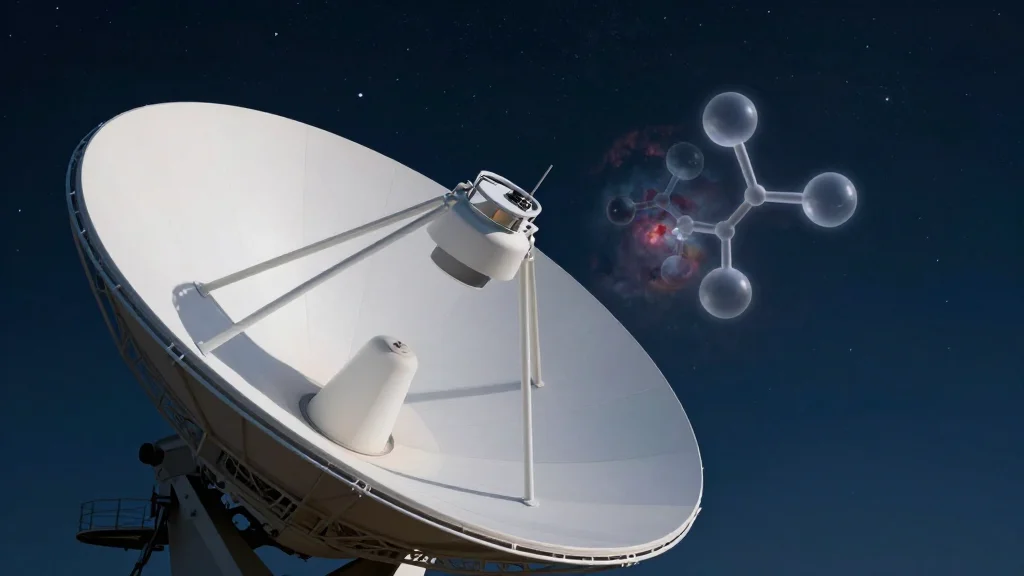
Astronomers Find a Four-Carbon Sugar in Deep Space
Why It Matters
The discovery demonstrates that complex, life‑related sugars can arise in space and be delivered to planets, strengthening models of extraterrestrial contributions to the origin of life.
Key Takeaways
- •Erythrulose detected in molecular cloud G+0.693‑0.027.
- •Detection confidence 99.8% (0.2% false‑positive chance).
- •Four‑carbon sugar outnumbers three‑carbon analogs by factor of eight.
- •Formation likely via two‑carbon fragments on icy dust grains.
- •Supports TNA precursor delivery hypothesis during Late Heavy Bombardment.
Pulse Analysis
Interstellar chemistry has long revealed a surprising inventory of organic molecules, from simple hydrocarbons to amino‑acid precursors. The recent identification of erythrulose—a four‑carbon ketose sugar—adds a new dimension to this catalog, showing that sugars larger than three carbons can form in the harsh vacuum of space. By leveraging high‑resolution spectra from the Yebes and IRAM facilities, researchers isolated distinct rotational lines that match laboratory signatures, achieving a detection confidence that leaves only a 0.2% probability of coincidence. This breakthrough underscores the growing sensitivity of radio astronomy in probing the molecular richness of dense clouds.
The formation pathway proposed by the team departs from traditional stepwise carbon accretion models. Instead, kinetic Monte Carlo simulations indicate that two‑carbon fragments such as glycoaldehyde and ethylene glycol, generated on icy dust grain surfaces by cosmic‑ray bombardment, can recombine to produce erythrulose directly. Quantum‑chemical calculations support the energetic feasibility of this route, suggesting that radical chemistry on grain mantles can bypass the need for three‑carbon intermediates. This mechanism not only explains the observed eight‑fold excess of erythrulose over glyceraldehyde but also provides a plausible route for generating other complex sugars that could seed nascent biochemistry.
From an astrobiological perspective, the presence of a four‑carbon sugar in the interstellar medium bridges a critical gap between cosmic chemistry and terrestrial pre‑life chemistry. Threose nucleic acid (TNA), which uses a four‑carbon backbone, is a leading candidate for an early genetic polymer that predates RNA. Erythrulose can isomerize into threose under aqueous conditions, implying that delivery of such sugars via cometary or meteoritic material during the Late Heavy Bombardment could have supplied the raw ingredients for primitive genetic systems. The finding fuels ongoing debates about panspermia and the universality of life's chemical precursors, while highlighting the need for further observational campaigns and laboratory analog studies to map the full spectrum of interstellar sugars. Future missions targeting icy bodies and improved spectroscopic surveys will be essential to quantify how widespread these prebiotic molecules truly are.
Astronomers find a four-carbon sugar in deep space
Comments
Want to join the conversation?
Loading comments...