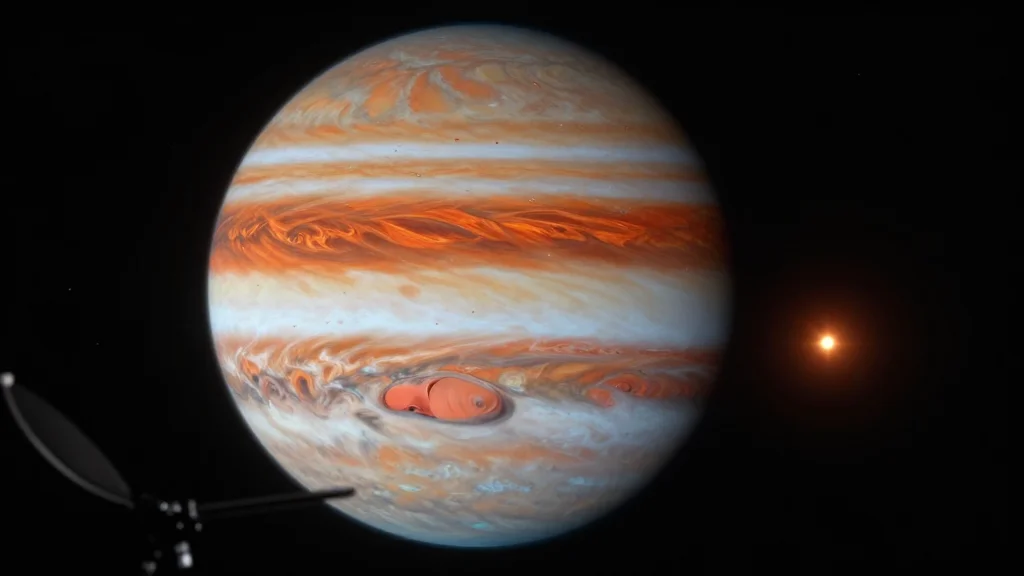
Astronomers Find an Exo-Jupiter, and It Seems to Have Clouds
Why It Matters
Cloudy atmospheres on warm Jupiters reshape expectations for exoplanet climate dynamics, influencing future telescope missions and the broader space‑tech market. The finding also validates JWST’s capability to probe detailed exoplanetary weather, driving demand for advanced data‑analysis services.
Key Takeaways
- •Mira b, a 1.2‑Jupiter‑mass exoplanet, orbits 300 ly away.
- •JWST spectroscopy reveals silicate and iron clouds in its atmosphere.
- •Planet's temperature ~900 K, cooler than typical hot Jupiters.
- •Cloud detection refines models of exoplanetary weather patterns.
- •Findings boost demand for next‑gen space telescopes and data services.
Pulse Analysis
The detection of clouds on Mira b underscores a new frontier in exoplanetary science. While hot Jupiters have long been known for their scorching, cloud‑free skies, this warm giant exhibits silicate and iron condensates that form high‑altitude layers. Such atmospheric complexity challenges existing models that assumed clear, hydrogen‑dominated envelopes for planets in this temperature regime. Researchers now have a tangible benchmark to test cloud‑formation theories, improving predictions for a broader class of exoplanets discovered by transit and radial‑velocity surveys.
James Webb’s near‑infrared spectrograph proved pivotal, delivering high‑resolution spectra that captured subtle absorption features indicative of mineral clouds. The instrument’s sensitivity demonstrates why space‑based observatories are essential for characterizing distant worlds, especially those whose signals are drowned out by stellar glare in ground‑based observations. This success fuels investor confidence in next‑generation telescopes like the Nancy Grace Roman Space Telescope and the European Extremely Large Telescope, which promise even finer atmospheric detail and larger survey volumes.
Beyond academia, the commercial implications are significant. Cloud‑rich exoplanet data create new opportunities for data‑analytics firms, AI‑driven modeling platforms, and satellite‑communication providers seeking to transmit large datasets. Moreover, the public’s fascination with alien weather systems can drive consumer interest in space‑related products, from educational kits to virtual reality experiences. As the industry pivots toward more sophisticated exoplanet exploration, the Mira b discovery signals a lucrative convergence of scientific insight and market demand.
Astronomers Find an Exo-Jupiter, and It Seems to Have Clouds
Comments
Want to join the conversation?
Loading comments...