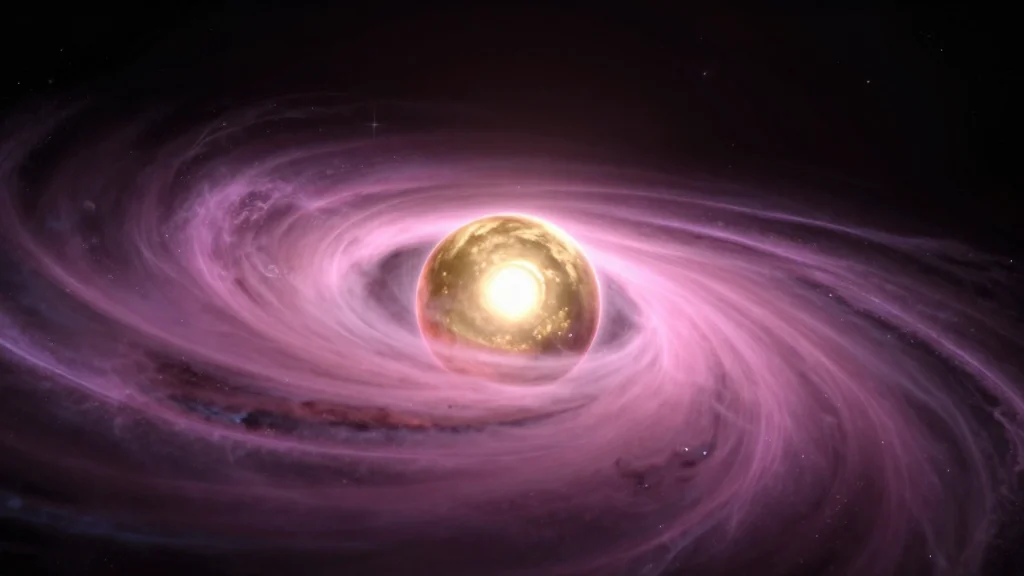
Astronomers Find Another Quasar in the Early Universe that Really Shouldn’t Be There
Why It Matters
The discovery forces a reassessment of how supermassive black holes can form and mature within the first billion years, challenging prevailing models of galaxy evolution and Big Bang cosmology.
Key Takeaways
- •Quasar discovered 850 Myr after Big Bang shows flat accretion disk.
- •Flickering varies ~20% in power, first of its kind at this epoch.
- •Energy output equals ~12 trillion solar luminosities.
- •Findings challenge models of rapid supermassive black‑hole growth.
- •About 200 similar early quasars already identified, defying standard cosmology.
Pulse Analysis
The new quasar was uncovered by mining data from NASA's Wide‑field Infrared Survey Explorer (WISE), a telescope that continues to yield surprises years after its primary mission ended. By detecting subtle variations in infrared brightness, researchers pinpointed a source whose light has traveled over 13 billion years, revealing a galaxy that was already hosting a supermassive black hole when the universe was less than a billion years old. This discovery underscores the value of archival surveys for probing the most distant, faint objects that modern telescopes may miss.
What makes this quasar particularly intriguing is its flat, pancake‑like accretion disk—a geometry traditionally associated with mature, stable black holes. Early‑universe black holes are expected to accrete gas in a chaotic, puffed‑up fashion, yet the observed disk suggests a level of order and efficiency that current growth models struggle to explain. The 20 percent flickering in its output provides a rare diagnostic of the inner engine, hinting at rapid, perhaps episodic feeding mechanisms that could accelerate mass accumulation far beyond standard predictions.
The broader implication is a growing tension between observations and the standard Lambda‑Cold Dark Matter framework, which predicts insufficient time for such massive black holes to form. As the catalog of early quasars swells to roughly 200, astronomers anticipate that next‑generation facilities like the James Webb Space Telescope and the upcoming Nancy Grace Roman Space Telescope will deliver higher‑resolution spectra, helping to refine black‑hole seed theories. Until then, each new outlier serves as a catalyst for re‑examining the physics of the early universe and the timelines of galaxy assembly.
Astronomers find another quasar in the early universe that really shouldn’t be there
Comments
Want to join the conversation?
Loading comments...