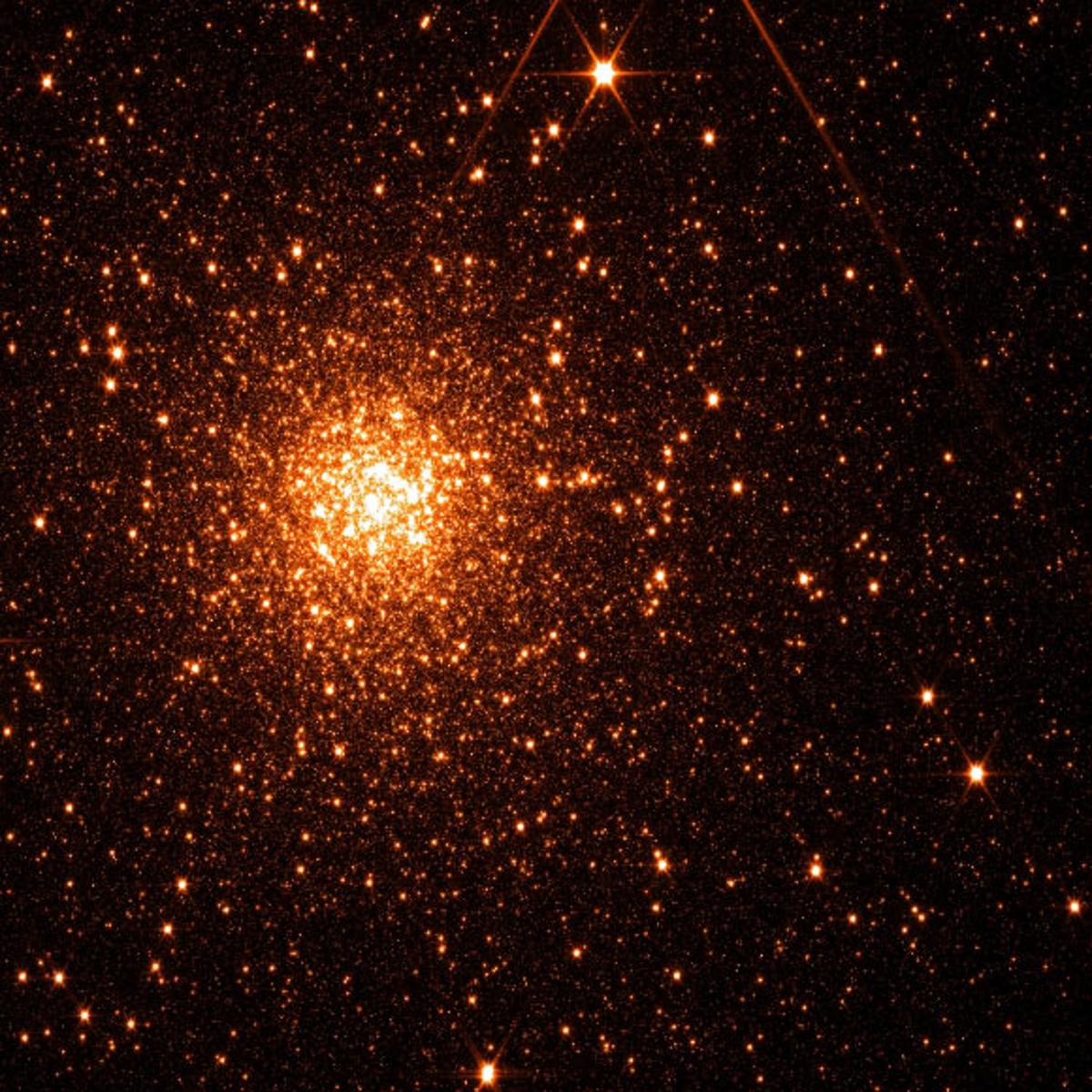
Astronomers Find Four Separate Generations of Stars in ‘Globular Cluster’ Terzan 5
Why It Matters
The discovery rewrites how astronomers view bulge formation, showing that sizable stellar systems can retain gas and form stars over billions of years. It also provides a rare fossil record of the Milky Way’s early chemical evolution.
Key Takeaways
- •JWST and Hubble reveal four distinct stellar generations in Terzan 5.
- •Ages span 12.5 billion to 2.5 billion years, showing prolonged star formation.
- •Terzan 5 is a massive bulge fossil fragment, not a typical globular cluster.
- •Retained supernova ejecta enabled multiple generations, indicating high original mass.
- •Study reshapes view of Milky Way bulge assembly and early galaxy evolution.
Pulse Analysis
Globular clusters have long been considered simple stellar systems, each born in a single burst of star formation. Terzan 5, long classified as a globular cluster, defies that paradigm. By exploiting JWST’s near‑infrared sensitivity to pierce the dust‑laden Galactic bulge and Hubble’s 12‑year baseline for precise proper‑motion tracking, researchers isolated cluster members and charted their color‑magnitude diagrams. The resulting data uncovered four separate epochs of star birth, ranging from the epoch of the Milky Way’s assembly to just 2.5 billion years ago, a timeline unprecedented for any known cluster.
The multi‑age structure is reinforced by spectroscopic signatures from Keck and the VLT, which show distinct metallicities and alpha‑element abundances for each population. These chemical fingerprints reveal that Terzan 5 retained the heavy elements forged in successive supernova explosions, a capability only a system with a deep gravitational well can sustain. Consequently, the cluster likely originated as a far more massive proto‑bulge fragment, capable of holding onto gas and dust that would otherwise be expelled in lower‑mass environments. This retention enabled repeated cycles of star formation, turning Terzan 5 into a living archive of the Milky Way’s early enrichment processes.
The broader implication is a shift in how astronomers model bulge formation. Rather than a smooth, monolithic collapse, the bulge may have assembled from numerous massive clumps like Terzan 5, each contributing its own chemically enriched stars. Recognizing such fossil fragments reshapes theories of galaxy evolution and informs future surveys targeting similar relics. As JWST continues to map obscured regions of the Milky Way, more hidden, multi‑generation systems may emerge, offering deeper insight into the complex history of our galaxy’s heart.
Astronomers Find Four Separate Generations of Stars in ‘Globular Cluster’ Terzan 5
Comments
Want to join the conversation?
Loading comments...