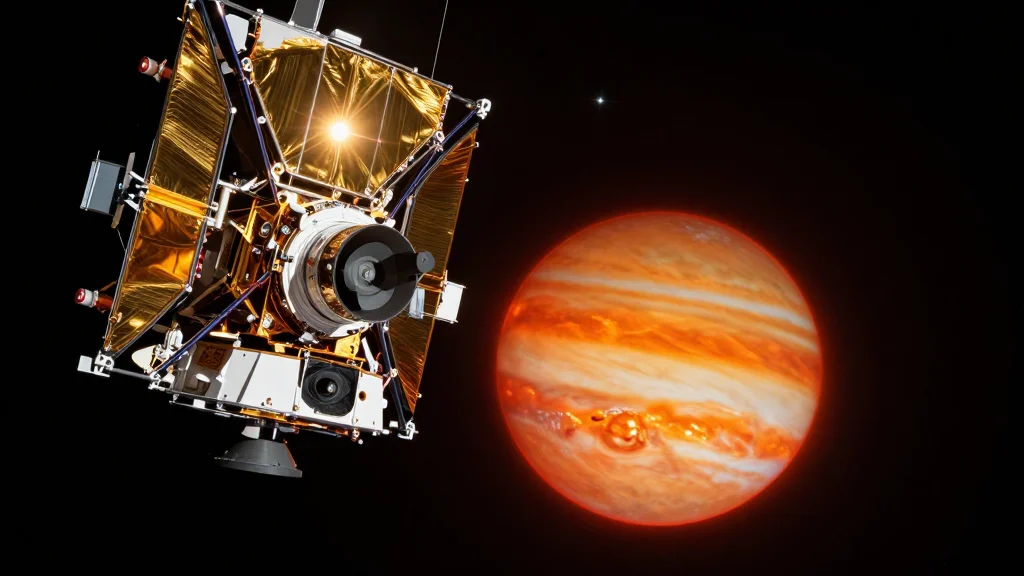
Astronomers Find Variations Between the Morning and the Evening Conditions of an Ultra-Hot Exoplanet
Why It Matters
The discovery reshapes our understanding of heat redistribution and chemistry on ultra‑hot Jupiters, influencing atmospheric models and future observation strategies. It signals that phase‑resolved spectroscopy can act as a weather radar for distant worlds.
Key Takeaways
- •WASP-121b shows distinct morning vs. evening temperature profiles
- •JWST spectra reveal varying ionized metal signatures across terminator
- •Heat transport appears less efficient than predicted by models
- •Findings challenge assumptions about cloud formation on ultra‑hot Jupiters
- •Study opens path for phase‑resolved exoplanet weather mapping
Pulse Analysis
Astronomers using the James Webb Space Telescope (JWST) have captured the first high‑resolution, phase‑resolved spectra of the ultra‑hot Jupiter WASP‑121b, revealing a clear dichotomy between its morning (dawn) and evening (dusk) limbs. By observing the planet as it orbits its host star, the team measured temperature gradients of up to 1,500 K and detected distinct absorption features that shift with orbital phase. This level of detail surpasses earlier Hubble observations and marks a milestone in characterizing exoplanet weather patterns. The data also capture subtle variations in water vapor absorption, hinting at localized cloud decks.
The morning side appears cooler and richer in neutral atoms, while the evening side shows hotter temperatures and strong ionized metal lines such as Fe II and Ti II. These variations suggest that heat redistribution is hampered by rapid radiative cooling, and that chemical recombination cycles differ across the terminator. Existing circulation models, which often assume uniform east‑west winds, struggle to reproduce the observed asymmetry, prompting a reassessment of drag forces and magnetic effects in ultra‑hot atmospheres. Magnetic drag, induced by the planet's strong field, may further suppress eastward jet streams.
Beyond WASP‑121b, the study demonstrates that phase‑resolved spectroscopy can serve as a weather radar for distant worlds, enabling astronomers to map temperature, composition, and cloud formation in real time. The findings will inform the design of upcoming JWST programs and ground‑based facilities such as the Extremely Large Telescope, which aim to probe smaller, cooler planets with similar techniques. Ultimately, these insights will refine habitability criteria for rocky exoplanets orbiting active stars. As the catalog of exoplanets with detailed atmospheric maps expands, comparative planetology will gain a new dimension, sharpening our understanding of planetary climate dynamics across the galaxy.
Astronomers Find Variations Between the Morning and the Evening Conditions of an Ultra-Hot Exoplanet
Comments
Want to join the conversation?
Loading comments...