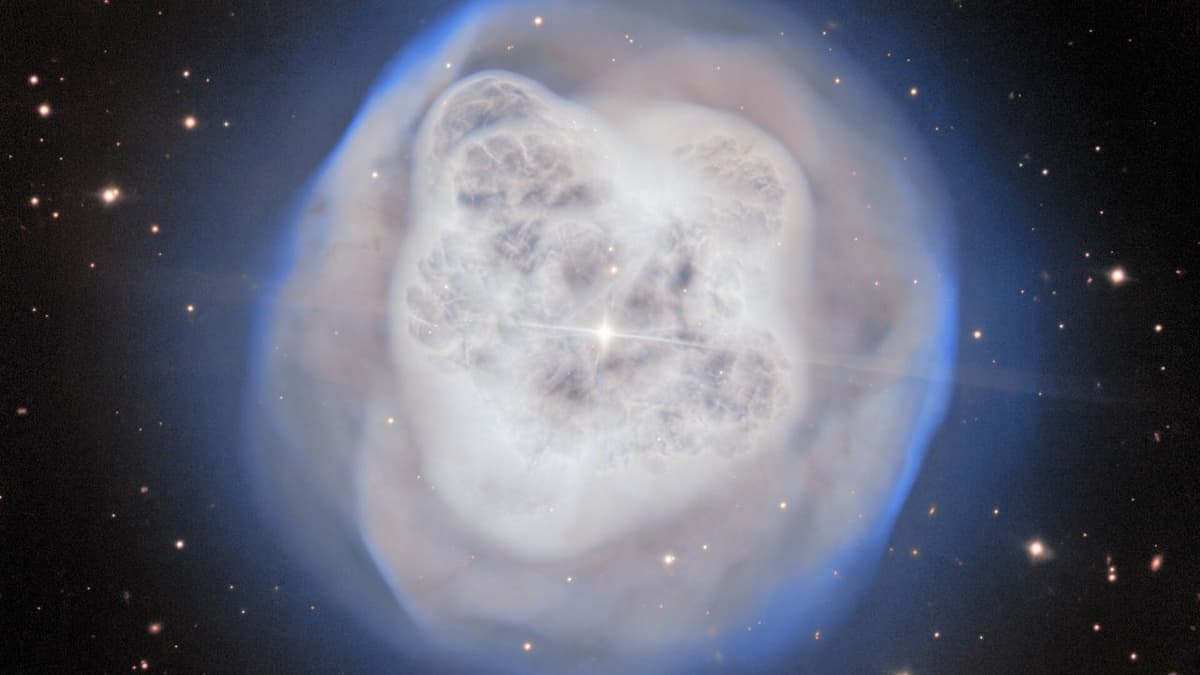
Astronomers Gaze Into the 'Crystal Ball Nebula' And See a Vision of Our Dying Sun — Space Photo of the Week
Why It Matters
Understanding the dynamics of binary‑driven planetary nebulae refines models of stellar death, directly informing predictions for the Sun’s ultimate fate and the chemical enrichment of the galaxy.
Key Takeaways
- •Gemini North telescope captured the clearest image of NGC 1514.
- •Nebula’s central binary orbits every nine years, longest known period.
- •Crystal Ball Nebula visualizes the Sun’s future planetary nebula stage.
- •Binary interaction sculpts asymmetric, lumpy nebular structure.
- •Observations aid models of stellar evolution and galactic enrichment.
Pulse Analysis
The Crystal Ball Nebula (NGC 1514) has long intrigued astronomers, but the latest Gemini North exposure delivers unprecedented clarity. By harnessing adaptive optics and infrared sensors, the telescope pierced the nebula’s diffuse veil, revealing fine filaments and a bright central core. This visual breakthrough not only honors William Herschel’s 1790 discovery but also provides a benchmark for calibrating future planetary‑nebula surveys, allowing researchers to compare structural details across dozens of similar objects.
At the heart of NGC 1514 lies a tightly bound binary star pair that completes an orbit every nine years, making it the longest‑period binary identified within a planetary nebula. Such systems inject angular momentum into the ejected gas, generating the lumpy, popcorn‑like morphology captured in the image. Astrophysicists use these dynamics to test theories of mass loss, wind shaping, and magnetic field interactions during the late stages of stellar evolution. The binary’s asymmetric stellar wind also enriches surrounding interstellar material with heavier elements, seeding future star‑forming regions.
For the broader public, the nebula serves as a cosmic time capsule, projecting the Sun’s destiny in roughly five billion years. As our star exhausts hydrogen, it will swell into a red giant before shedding its outer layers to form a planetary nebula akin to the Crystal Ball. Studying such analogues sharpens predictions about Earth’s ultimate fate and informs models of galactic chemical cycles. Continued observations with next‑generation observatories promise deeper insight into how binary companions dictate the final act of stellar life.
Astronomers gaze into the 'Crystal Ball Nebula' and see a vision of our dying sun — Space photo of the week
Comments
Want to join the conversation?
Loading comments...