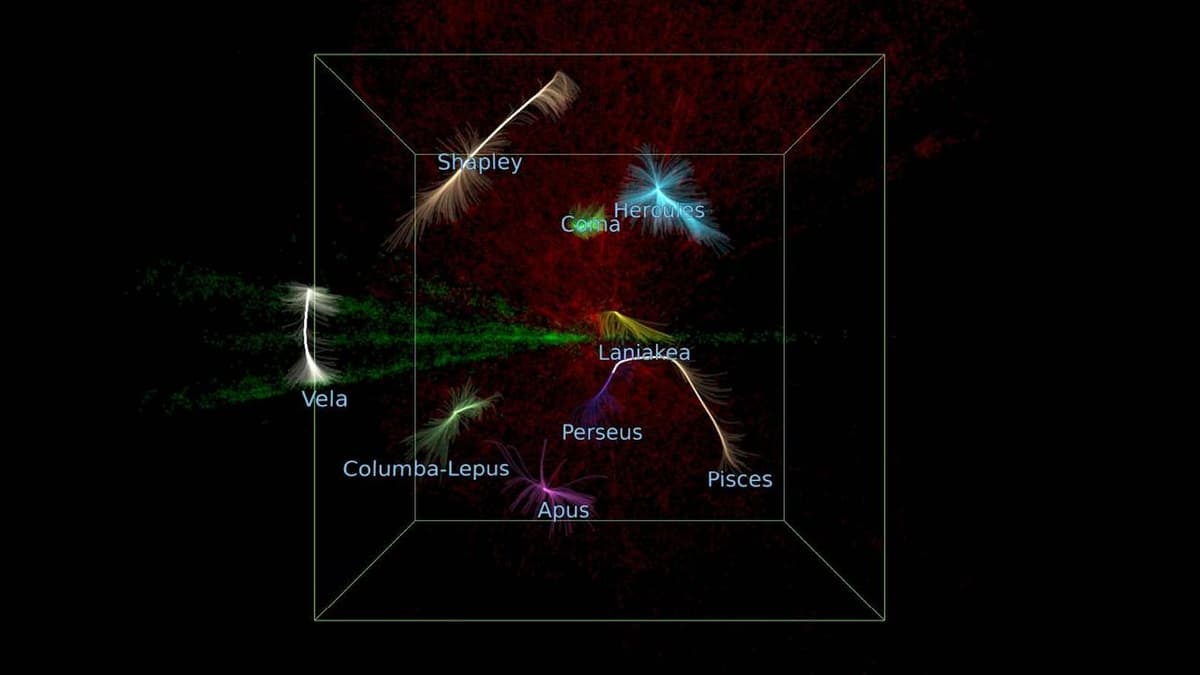
Astronomers Just Mapped One of the Largest Structures in the Universe, Long Hidden Behind the Milky Way's 'Zone of Avoidance'
Why It Matters
Mapping Vela clarifies the distribution of mass in the nearby universe, offering a critical data point for refining cosmological theories. It also demonstrates the power of radio‑based surveys to pierce the Milky Way’s obscuring dust, opening up previously inaccessible regions of the sky.
Key Takeaways
- •Vela Supercluster spans ~300 million light‑years, rivaling Shapley
- •Contains mass equivalent to 30 quadrillion suns, exceeding Laniākea
- •Mapped using 65k distances and 8k new redshifts, including MeerKAT data
- •Reveals hidden large‑scale structure, testing cosmological models
Pulse Analysis
The Vela Supercluster’s emergence from the so‑called Zone of Avoidance marks a watershed moment for extragalactic astronomy. By integrating a massive catalog of galaxy distances with fresh redshift data, the team resolved a structure that had eluded optical surveys for decades. The resulting map, anchored by MeerKAT’s radio observations of hydrogen emissions, showcases how multi‑wavelength approaches can overcome the Milky Way’s dense star and dust veil, delivering a three‑dimensional view of a region that accounts for roughly 20% of the sky.
The technical feat hinges on the synergy between traditional distance indicators and high‑precision redshift measurements. Approximately 65,000 legacy distance entries were cross‑matched with 8,000 new redshifts, of which 2,000 originated from MeerKAT’s sensitive array in South Africa. This hybrid reconstruction not only delineated two massive cores moving toward each other but also quantified the supercluster’s total mass at about 30 quadrillion solar equivalents. As radio facilities like the upcoming Square Kilometre Array come online, astronomers anticipate even finer mapping of Vela’s peripheral regions, though some hydrogen‑poor galaxies will likely remain invisible.
Beyond the sheer scale, Vela’s discovery carries profound cosmological implications. Its size and velocity field provide a new laboratory for testing the Lambda‑Cold Dark Matter model and alternative gravity theories, especially when contrasted with the Shapley and Laniākea superclusters. By anchoring the local large‑scale structure, Vela helps resolve discrepancies between observed galaxy flows and theoretical predictions, sharpening our understanding of dark matter distribution and the universe’s expansion history. Future surveys that extend this methodology could uncover additional hidden superclusters, further refining the cosmic web’s map.
Astronomers just mapped one of the largest structures in the universe, long hidden behind the Milky Way's 'Zone of Avoidance'
Comments
Want to join the conversation?
Loading comments...