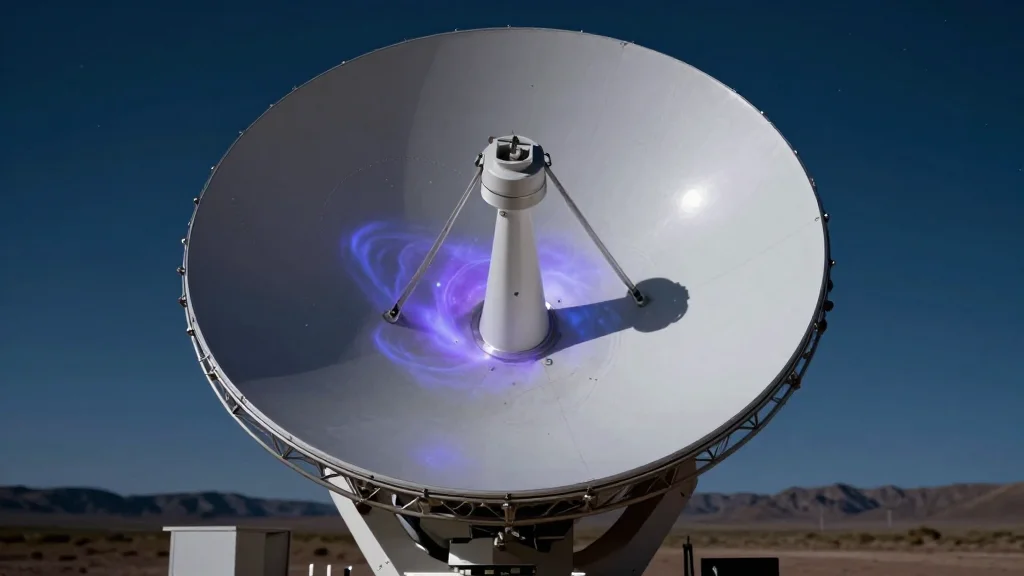
Astronomers Locate Missing Ordinary Matter in Vast Cosmic Hydrogen Clouds

Why It Matters
Accounting for the missing ordinary matter resolves a fundamental discrepancy in the standard cosmological model, improving the accuracy of simulations that predict galaxy formation and evolution. By confirming that diffuse ionized hydrogen makes up the bulk of the unseen baryons, scientists can better calibrate the role of feedback mechanisms—such as energy released by supermassive black holes—in shaping the large‑scale structure of the universe. The result also demonstrates the power of combining massive spectroscopic surveys with high‑precision CMB observations, a methodological template that will be essential for future probes of dark matter, dark energy, and the early universe. As the community integrates these findings, theoretical models will be forced to incorporate a more extensive circumgalactic medium, potentially altering predictions for the distribution of matter on scales from individual galaxies to the cosmic web.
Key Takeaways
- •Astronomers used DESI galaxy data and ACT CMB maps to detect diffuse ionized hydrogen.
- •The kinematic Sunyaev‑Zel’dovich effect enabled indirect observation of otherwise invisible gas.
- •Ionized hydrogen extends up to five times farther from galaxies than previously thought.
- •The newly identified gas accounts for roughly half of the universe's missing ordinary matter.
- •Findings will influence models of galaxy formation, AGN feedback, and future cosmological surveys.
Pulse Analysis
The detection of the missing baryons is more than a bookkeeping triumph; it validates a class of cosmological probes that rely on subtle CMB distortions rather than direct emission. Historically, the “missing baryon” problem has persisted because most observational tools target dense, luminous structures, leaving low‑density gas undetected. By leveraging the statistical power of millions of galaxies and the exquisite sensitivity of modern CMB experiments, the team has turned a weakness—our inability to see faint gas—into a strength.
From a competitive standpoint, this work underscores the strategic advantage of institutions that can integrate large‑scale spectroscopic datasets with high‑resolution microwave observations. The collaboration between DESI and ACT sets a precedent for future joint analyses, such as those planned with the Simons Observatory and CMB‑S4. As these next‑generation facilities come online, the precision of kSZ measurements will improve dramatically, potentially allowing astronomers to map the baryon distribution in three dimensions and over a broader redshift range.
Looking ahead, the discovery will likely catalyze revisions to semi‑analytic models of galaxy evolution, which have historically underestimated the mass and extent of circumgalactic gas. Incorporating a more massive, diffuse halo could alter predictions for star‑formation efficiency, metal enrichment, and the thermal history of the intergalactic medium. In turn, these adjustments will feed back into constraints on dark energy and the growth of cosmic structure, making the finding a cornerstone for both astrophysics and fundamental cosmology.
Astronomers Locate Missing Ordinary Matter in Vast Cosmic Hydrogen Clouds
Comments
Want to join the conversation?
Loading comments...