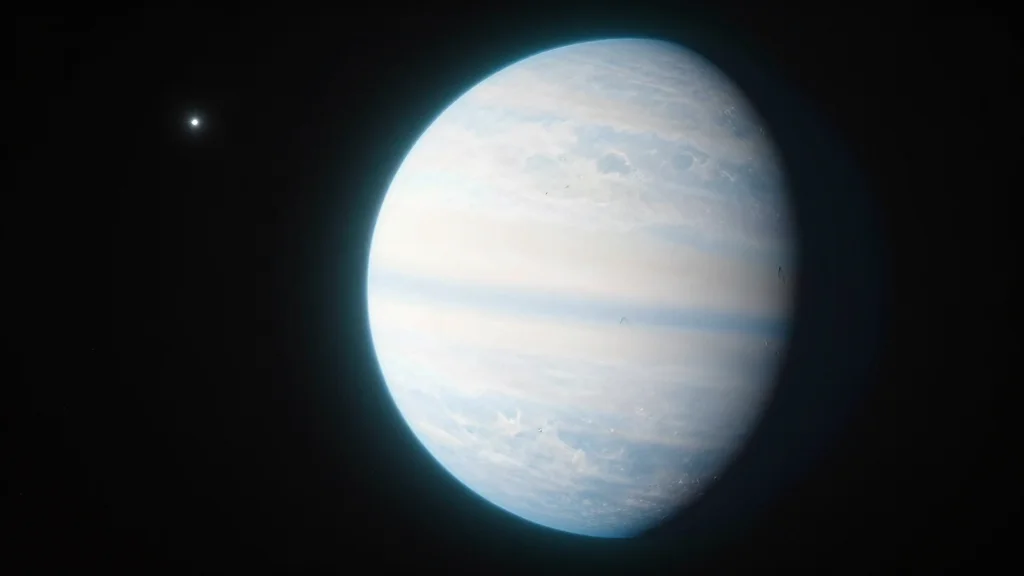
Astronomers May Have Detected an Atmosphere Around a Tiny, Icy World Past Pluto

Companies Mentioned

NASA

Associated Press
Why It Matters
Detecting an atmosphere on such a tiny, distant object reshapes our understanding of how volatile gases can be retained on small Kuiper Belt bodies, influencing models of solar‑system formation and evolution. It also opens a new class of targets for upcoming telescopes like JWST, potentially revealing diverse atmospheric processes beyond the traditional planets and dwarf planets.
Key Takeaways
- •2002 XV93 is ~500 km wide, smallest body with detected atmosphere.
- •Atmosphere 5–10 million times thinner than Earth's, 50–100× thinner than Pluto's.
- •Likely gases: methane, nitrogen, or carbon monoxide from eruptions or impacts.
- •Detection made via stellar occultation, dimming of background star.
- •Future JWST observations could confirm composition and dynamics.
Pulse Analysis
The Kuiper Belt, a vast reservoir of icy remnants beyond Neptune, has long been a laboratory for studying the solar system’s primordial ingredients. Until now, only Pluto—a dwarf planet roughly 2,400 km across—had a confirmed atmosphere, a tenuous veil of nitrogen, methane, and carbon monoxide. The new detection around 2002 XV93, a minor planet just 500 km in diameter, pushes the lower size limit for atmospheric retention and suggests that even modestly sized bodies can sustain volatile envelopes under the right conditions.
The atmosphere’s existence was inferred through a stellar occultation, where the distant object briefly blocked a background star, causing a subtle dimming pattern that revealed the presence of gas. Researchers estimate the pressure to be 5‑10 million times lower than Earth’s, yet sufficient to produce measurable absorption signatures. Potential sources include cryovolcanic outgassing—akin to geysers on Enceladus—or the impact of a comet delivering fresh volatiles. The composition, likely a mix of methane, nitrogen, or carbon monoxide, mirrors that of larger Kuiper Belt objects, hinting at common chemical pathways across the region.
This discovery carries profound implications for planetary science. It challenges existing models that tie atmospheric survival to mass and distance, prompting a reevaluation of how heat, radiation, and internal activity interact on small worlds. Upcoming observations with the James Webb Space Telescope could directly probe the gas composition, temperature, and dynamics, offering a rare glimpse into atmospheric processes on the solar system’s smallest scales. As more minor planets are surveyed, we may find that thin atmospheres are a widespread, albeit fleeting, feature of the distant icy frontier.
Astronomers May Have Detected an Atmosphere Around a Tiny, Icy World Past Pluto
Comments
Want to join the conversation?
Loading comments...