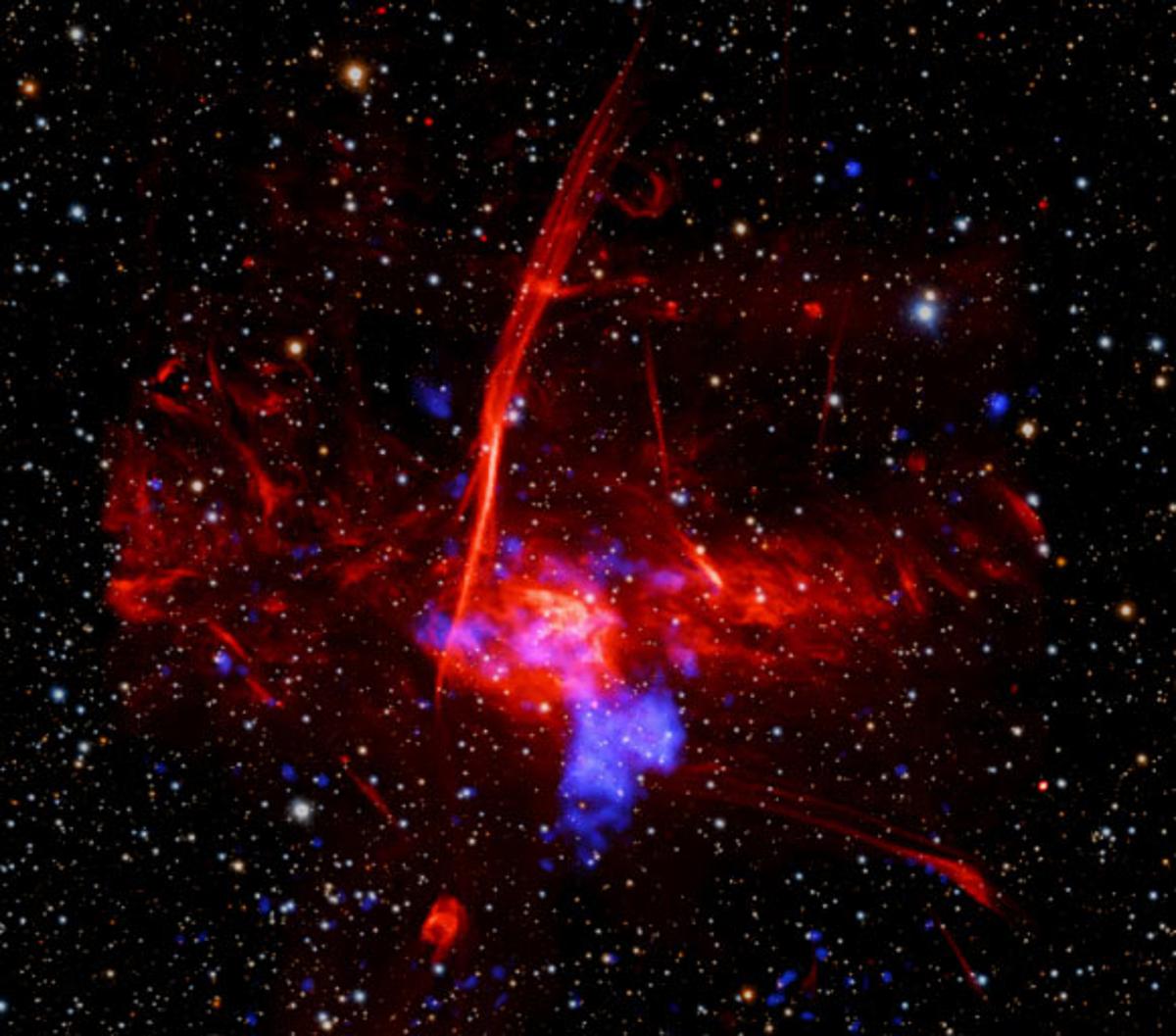
Astronomers May Have Found Supernova Remnant Near Milky Way’s Central Black Hole
Why It Matters
A supernova remnant so close to the Galactic center offers a rare laboratory for studying how massive star explosions influence the extreme environment around a supermassive black hole, shaping chemical enrichment and gas dynamics.
Key Takeaways
- •Supernova remnant candidate found ~26,000 light‑years from Earth
- •X‑ray blob expands at ~3.2 million km/h, ~1,700‑year age
- •Chandra, XMM‑Newton, MeerKAT data combined to reveal structure
- •No elemental enrichment detected, suggesting mixing with surrounding gas
- •Discovery informs star formation and chemical enrichment near Galactic center
Pulse Analysis
The heart of the Milky Way is a turbulent arena where gravity, magnetic fields and radiation interact in ways that are difficult to observe from our solar neighborhood. By leveraging the high‑resolution X‑ray imaging of Chandra and the broad‑band capabilities of XMM‑Newton, astronomers have pierced the dense dust clouds that normally obscure the region. Adding MeerKAT’s radio view creates a multi‑wavelength portrait, allowing the faint X‑ray "blob" to stand out against the bright Sagittarius C HII region. This synergy illustrates how coordinated space‑based and ground‑based facilities can uncover hidden astrophysical phenomena.
Supernova remnants near a supermassive black hole are especially valuable because they inject freshly forged heavy elements into an environment already rich in energetic particles and strong magnetic fields. The identified remnant’s expansion speed—about 3.2 million km per hour—implies an age of roughly 1,700 years, placing the explosion in the relatively recent Galactic past. Although the X‑ray spectra lack a clear excess of elements like iron or silicon, the absence likely signals rapid mixing with the surrounding interstellar medium, a process that can accelerate chemical homogenization across the central molecular zone.
The discovery opens several avenues for future research. Detailed spectroscopy with upcoming missions such as XRISM and Athena could resolve subtle abundance patterns, while deeper radio mapping may trace the remnant’s shock front interacting with ambient magnetic filaments. Understanding how supernovae shape the gas reservoir feeding Sagittarius A* could refine models of black‑hole accretion cycles and star formation under extreme conditions. Ultimately, this finding underscores the importance of multi‑messenger observations in decoding the complex lifecycle of matter at the galaxy’s core.
Astronomers May Have Found Supernova Remnant near Milky Way’s Central Black Hole
Comments
Want to join the conversation?
Loading comments...