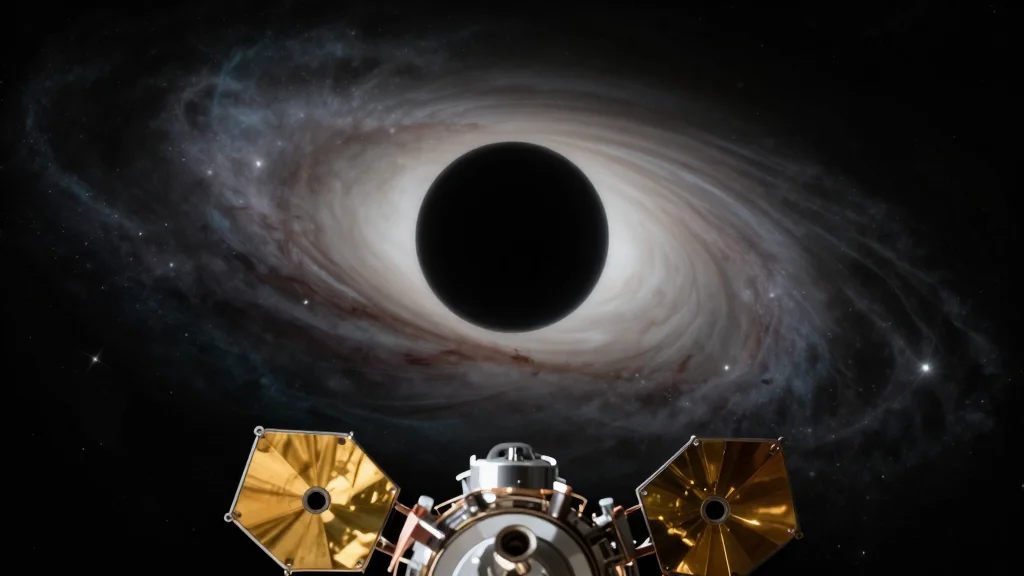
Astronomers Measure Weight of Supermassive Black Hole 10 Billion Light Years Away
Why It Matters
The discovery proves that JWST can apply precision dynamical methods at cosmological distances, reshaping models of how massive black holes formed quickly after the Big Bang. It supplies a concrete data point for testing theories of early‑universe galaxy evolution.
Key Takeaways
- •JWST measured a 6‑billion‑solar‑mass black hole 10 billion ly away
- •First use of stellar dynamics at cosmological distances
- •Black hole existed when universe was ~3 billion years old
- •Provides benchmark for early‑universe black‑hole growth models
Pulse Analysis
The James Webb Space Telescope’s infrared sensitivity and high‑resolution imaging have finally extended the stellar‑dynamics toolbox beyond the local universe. By resolving individual stars orbiting a dormant black hole at a redshift corresponding to 10 billion light‑years, researchers have demonstrated that JWST can capture the subtle gravitational signatures needed for precise mass estimates. This methodological breakthrough builds on decades of work measuring the Milky Way’s Sagittarius A* and other nearby nuclei, but now pushes the frontier to an era when galaxies were still assembling.
Understanding how a black hole can reach six billion solar masses in just three billion years challenges conventional accretion models. Traditional theories predict slower growth, requiring either super‑Eddington feeding or early massive seed black holes. The new measurement provides a rare anchor point for simulations, allowing astrophysicists to calibrate the efficiency of gas inflow, merger histories, and feedback mechanisms in the first few billion years of cosmic time. Comparisons with the relatively modest four‑million‑solar‑mass Sagittarius A* highlight the dramatic diversity of black‑hole evolution across epochs.
Looking ahead, the result sets a precedent for a systematic survey of distant, dormant black holes with JWST and upcoming facilities like the Nancy Grace Roman Space Telescope. As longer baselines of stellar motion accumulate, uncertainties will shrink, enabling tighter constraints on black‑hole mass functions at high redshift. These data will feed into broader cosmological models, informing dark‑matter halo formation and the co‑evolution of galaxies and their central engines. The era of precision black‑hole archaeology has begun, promising deeper insight into the universe’s formative years.
Astronomers measure weight of supermassive black hole 10 billion light years away
Comments
Want to join the conversation?
Loading comments...