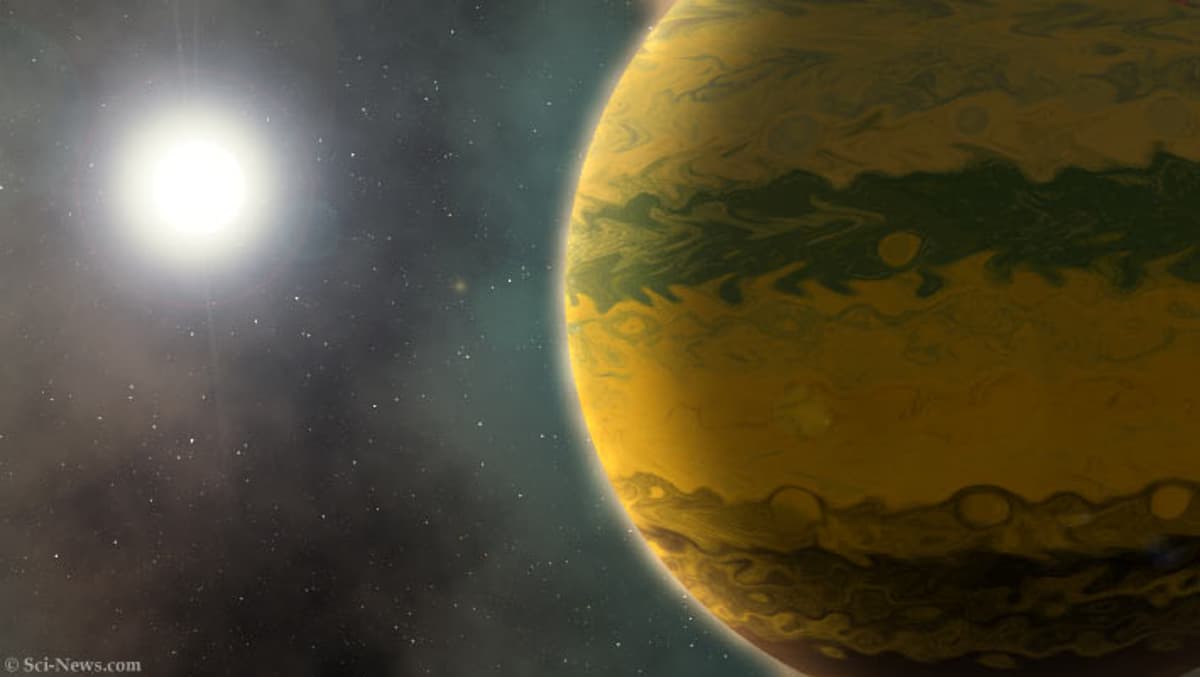
Astronomers Observe Shape-Shifting Planetary System: TOI-201
Why It Matters
The system provides a real‑time laboratory for studying orbital dynamics and planetary formation, challenging the assumption that planets form in aligned, coplanar disks. Observing the evolving transits will refine models of how massive companions influence inner planetary architectures.
Key Takeaways
- •TOI-201 hosts a super‑Earth, warm Jupiter, and an 8‑year brown dwarf.
- •Brown dwarf TOI-201c has the longest transiting period ever recorded.
- •Tilted orbital planes cause precession, altering transit visibility on century scales.
- •Next transit of TOI-201c scheduled for 26 Mar 2031, enabling follow‑up.
- •System challenges models of aligned protoplanetary‑disk formation.
Pulse Analysis
The discovery of TOI-201’s three‑body architecture adds a new dimension to the exoplanet field, which has traditionally focused on isolated hot Jupiters or compact multi‑planet systems. By combining a rocky super‑Earth, a warm giant, and a brown dwarf that straddles the planet‑star boundary, the system bridges gaps in our understanding of how diverse bodies can coexist around a single star. Its bright host star enables high‑precision spectroscopy, allowing researchers to probe atmospheric composition and orbital mechanics with unprecedented detail.
What sets TOI-201 apart is the pronounced misalignment among its companions. The brown dwarf’s massive, eccentric orbit exerts gravitational torques that slowly tilt the inner planets, causing their orbital planes to precess. This dynamical interaction leads to a predictable cycle of transit visibility, where each body will cease transiting within a few centuries before re‑emerging millennia later. Such observable orbital evolution on human timescales is exceedingly rare, offering a natural experiment to test theories of angular momentum exchange, migration, and the long‑term stability of multi‑body systems.
The upcoming 2031 transit of TOI‑201c presents a strategic window for the astronomical community. Ground‑based observatories, space telescopes, and even citizen‑science networks can coordinate to capture high‑resolution data, potentially revealing the brown dwarf’s atmospheric signatures and refining its mass estimate. These observations will not only calibrate models of brown‑dwarf formation—whether they arise like planets or stars—but also inform the broader quest to map the dynamical histories of planetary systems across the galaxy. The TOI-201 case underscores how continuous monitoring can transform static snapshots into dynamic narratives of planetary evolution.
Astronomers Observe Shape-Shifting Planetary System: TOI-201
Comments
Want to join the conversation?
Loading comments...