Key Takeaways
- •JWST detected water, CO2, SO2 in mini‑Neptune TOI‑1130 b.
- •Heavy atmosphere implies formation beyond the system’s frost line.
- •Both planets likely migrated inward together, preserving volatiles.
- •First atmosphere measured for planet inside hot Jupiter orbit.
- •Findings support outer‑disk formation channel for mini‑Neptunes.
Pulse Analysis
The coexistence of a hot Jupiter and an inner mini‑Neptune has long challenged conventional planet‑formation models, which typically place massive gas giants on solitary, close‑in orbits. Traditional theories argue that a hot Jupiter’s strong gravity would eject or prevent the formation of interior companions, making the TOI‑1130 system an outlier. By situating the pair near the star’s frost line—a region where temperatures are low enough for water ice to condense—researchers can reconcile the system’s architecture with a scenario where both bodies accreted volatile‑rich material before migrating inward.
JWST’s multi‑wavelength spectrograph delivered unprecedented sensitivity, capturing absorption signatures of heavy molecules in TOI‑1130 b’s atmosphere. The presence of water, carbon dioxide, sulfur dioxide and methane—molecules far heavier than hydrogen and helium—contradicts expectations for a planet that formed in situ, where intense stellar radiation would strip lighter gases and prevent accumulation of such volatiles. This atmospheric profile serves as a chemical fingerprint of formation beyond the ice line, supporting migration models that involve gradual inward drift through the protoplanetary disk while preserving atmospheric integrity.
The broader implication for exoplanet science is profound. Confirming an outer‑disk origin for a mini‑Neptune expands the known diversity of planetary formation pathways and suggests that similar “odd‑couple” systems may be more common than previously thought. Future JWST campaigns and upcoming missions like the Roman Space Telescope will target comparable resonant pairs, refining statistical models of migration and informing the search for worlds with stable, volatile‑rich atmospheres—key criteria in the assessment of habitability potential.
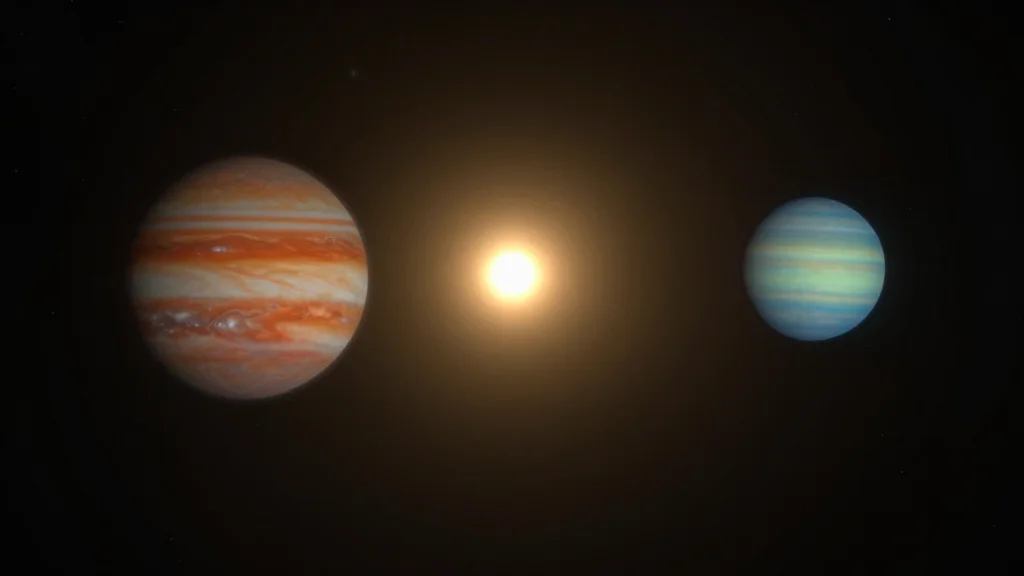
Astronomers pin down the origins of a planetary odd couple
Comments
Want to join the conversation?