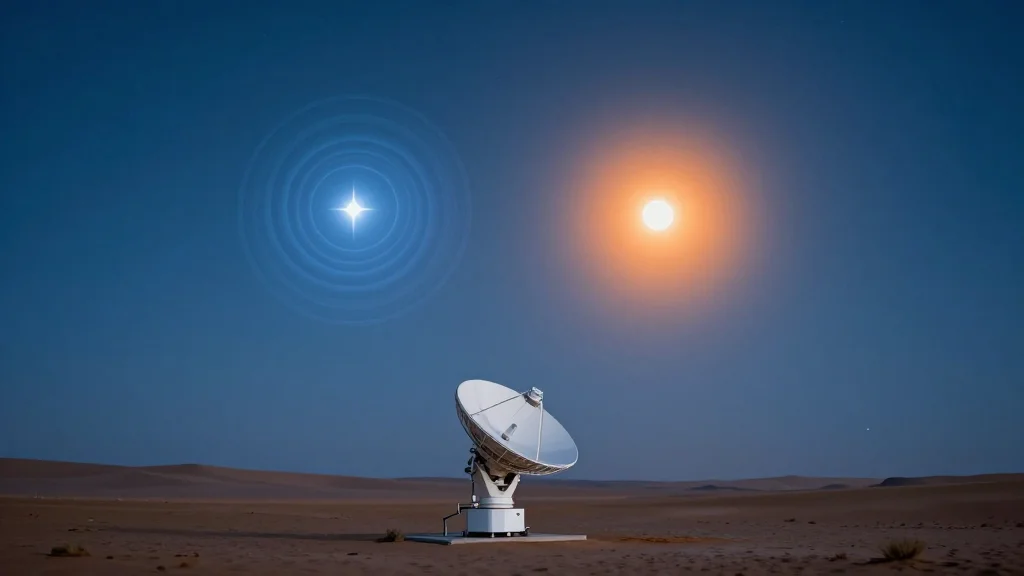
Astronomers Pinpoint Binary Origin of Repeating Radio Burst ASKAP J1745

Why It Matters
The identification of a binary origin for ASKAP J1745 transforms a long‑standing mystery into a testable astrophysical laboratory. By linking radio and X‑ray bursts to a specific orbital mechanism, scientists can now calibrate models of long‑period transients, improving predictions about their energy budgets, lifetimes, and population statistics. This has downstream effects on our understanding of stellar evolution, especially in extreme environments near the Galactic centre. For the SETI community, the work demonstrates a rigorous framework for separating natural astrophysical variability from potential technosignatures. As detection pipelines become more sophisticated, having a well‑characterized natural benchmark reduces false‑positive rates and sharpens the focus on truly anomalous signals. In short, the discovery not only solves a niche puzzle but also strengthens the methodological foundations of both high‑energy astronomy and the search for extraterrestrial intelligence.
Key Takeaways
- •ASKAP J1745 identified as a binary star system emitting paired radio and X‑ray bursts each orbit.
- •First long‑period transient with a confirmed astrophysical origin, out of only 12 known sources.
- •Study published in Nature Astronomy, using ASKAP and multiple X‑ray observatories.
- •Provides a concrete reference point for interpreting other mysterious long‑period transients.
- •Sets a new multi‑messenger standard for future SETI and high‑energy astrophysics surveys.
Pulse Analysis
The ASKAP J1745 breakthrough arrives at a pivotal moment for radio astronomy. Over the past decade, the field has shifted from cataloguing isolated bursts to building a taxonomy of transient phenomena, driven by instruments like CHIME and ASKAP that scan large swaths of sky daily. Yet, without a physical anchor, the long‑period transients have lingered on the periphery of mainstream astrophysics, often dismissed as curiosities. By tying a repeating burst to a binary orbit, the new study converts an outlier into a prototype, enabling theory to move from speculation to quantifiable physics.
Historically, the discovery of pulsars in 1967 turned a mysterious radio flicker into a cornerstone of neutron‑star science. ASKAP J1745 could play a similar role for a different regime—systems where accretion dynamics produce both coherent radio emission and high‑energy X‑ray flares. This dual‑band signature suggests that magnetic reconnection or shock acceleration in the binary’s interaction zone may be the engine, a hypothesis that can now be tested with targeted simulations and future observations.
From a strategic perspective, the result validates the multi‑messenger approach that funding agencies have been championing. The upcoming Square Kilometre Array will increase sensitivity by an order of magnitude, potentially uncovering hundreds of analogous systems. Coupled with next‑generation X‑ray missions like Athena, the community will be equipped to map the full parameter space of such binaries. For SETI, the lesson is clear: robust astrophysical classification reduces the noise floor, allowing genuine technosignature searches to focus on truly anomalous patterns. In the next five years, we can expect a cascade of discoveries that will either expand the binary‑origin catalog or reveal entirely new mechanisms, each reshaping our view of the dynamic radio sky.
Astronomers Pinpoint Binary Origin of Repeating Radio Burst ASKAP J1745
Comments
Want to join the conversation?
Loading comments...