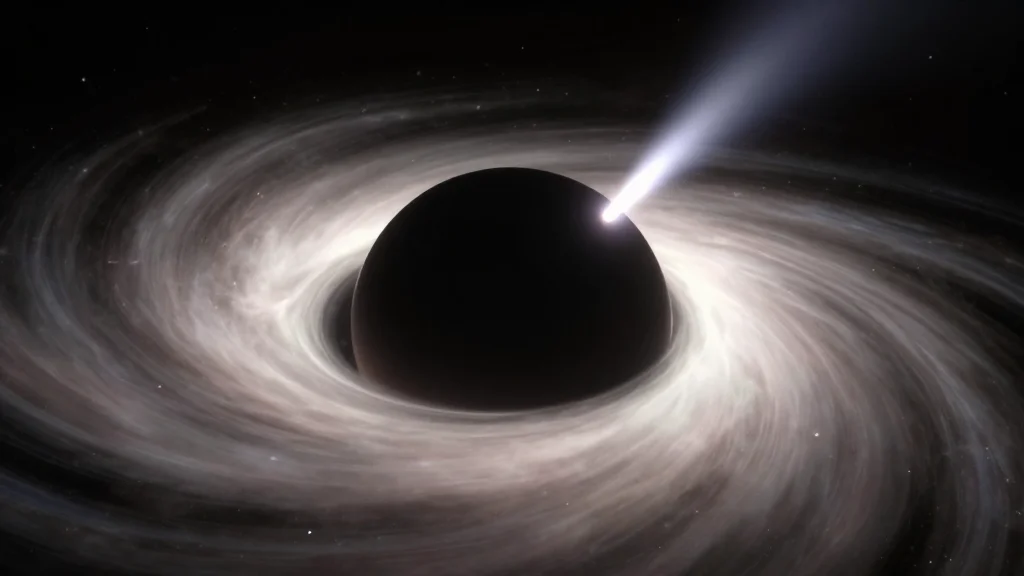
Astronomers Pinpoint Black Hole Jet Power at 10,000 Suns and Speed Half Light

Why It Matters
Directly measuring black‑hole jet power and speed resolves a key uncertainty in high‑energy astrophysics: how efficiently black holes convert infalling matter into relativistic outflows. This efficiency governs the amount of energy deposited into surrounding gas, shaping star formation rates and the growth of galaxies. By establishing a concrete 10 % conversion figure for Cygnus X‑1, the study provides a benchmark for simulations of galaxy evolution that rely on black‑hole feedback prescriptions. Beyond theoretical modeling, the breakthrough demonstrates the power of long‑baseline radio interferometry to capture rapid astrophysical phenomena. As next‑generation arrays come online, the method could become a standard tool, expanding our empirical grasp of jet physics from nearby stellar‑mass systems to the most massive black holes in the early universe. The resulting data will inform everything from the design of future space missions to the interpretation of high‑energy transients observed by gamma‑ray observatories.
Key Takeaways
- •Steve Prabu’s team measured Cygnus X‑1’s jet power at 10,000 solar luminosities.
- •Jet velocity recorded at 355 million mph, about 0.5 c.
- •Instantaneous measurement replaces previous millennia‑averaged estimates.
- •Findings suggest ~10 % of accreted energy is expelled via jets.
- •Technique poised for use on other black‑hole systems with upcoming ngVLA and SKA.
Pulse Analysis
The ability to pin down instantaneous jet energetics marks a paradigm shift akin to the first direct detection of gravitational waves. Where past studies could only infer average power, Prabu’s work captures the moment‑to‑moment vigor of a black‑hole engine, exposing the dynamical coupling between accretion flow and relativistic outflow. This granularity will force theorists to reconcile models that predict highly variable jet efficiencies with a concrete observational anchor.
Historically, black‑hole feedback has been a linchpin in cosmological simulations, yet its parametrization has been largely speculative. The 10 % efficiency measured here sits comfortably within the mid‑range of competing models, potentially narrowing the parameter space for large‑scale simulations of galaxy formation. If subsequent measurements across a diversity of masses and environments converge on a similar efficiency, it could herald a new era of predictive astrophysics where feedback is no longer a tunable knob but a measured quantity.
Looking ahead, the synergy between radio interferometry and high‑energy observatories will be crucial. Simultaneous X‑ray monitoring could reveal how changes in accretion rate translate into jet power swings, offering a real‑time laboratory for testing magnetohydrodynamic theories. As the ngVLA and SKA deliver sub‑milliarcsecond resolution, the community may soon map jet launching zones with unprecedented clarity, turning what was once a theoretical abstraction into a directly observable engine. This progression underscores why the Cygnus X‑1 measurement is more than a headline—it is the first step toward a systematic, quantitative understanding of black‑hole feedback across the cosmos.
Astronomers Pinpoint Black Hole Jet Power at 10,000 Suns and Speed Half Light
Comments
Want to join the conversation?
Loading comments...