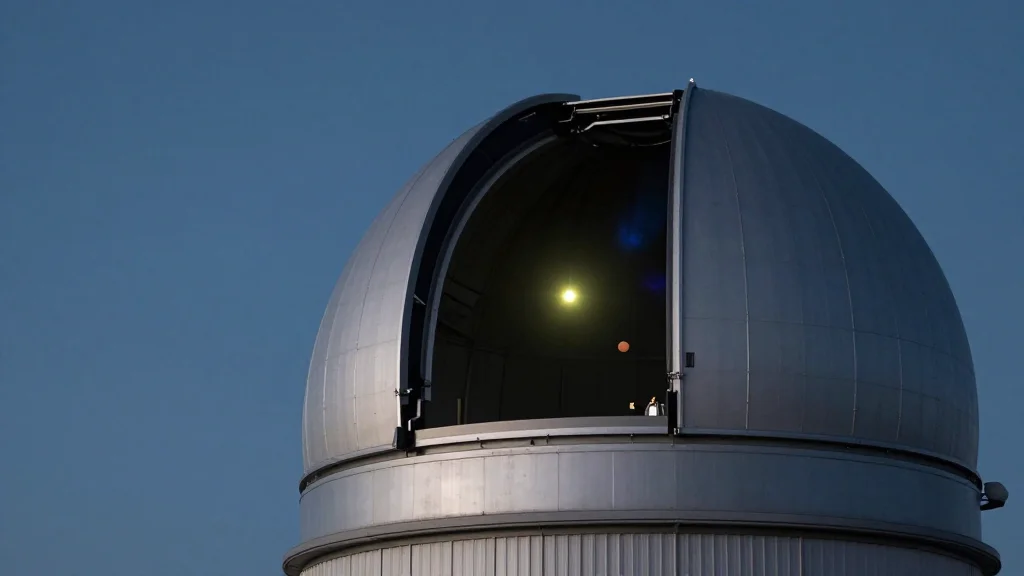
Astronomers Precisely Date Rare Brown Dwarf Companion, Offering New Test for How These Objects Cool
Why It Matters
The age anchor lets astronomers validate and refine brown dwarf cooling theories, a long‑standing uncertainty in substellar astrophysics. Accurate models are essential for interpreting the mass and temperature of isolated brown dwarfs and giant exoplanets.
Key Takeaways
- •HR 7672B age pinned at 2.3 billion years
- •Precise stellar age enables direct test of brown dwarf cooling models
- •Keck Planet Finder measured five‑minute stellar pulsations for age estimate
- •Findings favor newer interior physics models for substellar cooling
- •First reliable clock for a directly imaged brown dwarf companion
Pulse Analysis
Brown dwarfs occupy the mass gap between the heaviest planets and the lightest stars, radiating only residual heat as they gradually cool. Because they lack sustained nuclear fusion, their observable properties—luminosity, temperature, and spectrum—are tightly linked to age, yet most known brown dwarfs have uncertain chronologies. The HR 7672 system, discovered in 2002 through adaptive‑optics imaging at the Keck Observatory, has long served as a testbed for substellar studies, but without a precise stellar age the companion’s cooling curve remained speculative.
The UH team turned to asteroseismology, measuring five‑minute oscillations in HR 7672’s light with the Keck Planet Finder. These pulsations act as a stellar clock, yielding an age of roughly 2.3 billion years with unprecedented precision for a field star. Because the brown dwarf formed alongside its host, the same age applies to HR 7672B, anchoring its mass, luminosity, and temperature to a firm timeline. This methodology—combining high‑resolution spectroscopy with adaptive‑optics imaging—demonstrates that ground‑based facilities can now provide the chronological benchmarks once reserved for space missions.
Armed with a reliable age, the researchers compared HR 7672B’s observed properties against several evolutionary tracks. The data aligned best with newer models that incorporate refined equations of state and cloud physics, suggesting that earlier cooling curves may have oversimplified interior processes. This validation not only sharpens mass estimates for isolated brown dwarfs but also improves the characterization of massive exoplanets that share similar temperatures. As more host stars receive asteroseismic ages, the substellar community can expect a cascade of calibrated benchmarks, accelerating progress toward a unified theory of low‑mass object evolution.
Astronomers precisely date rare brown dwarf companion, offering new test for how these objects cool
Comments
Want to join the conversation?
Loading comments...