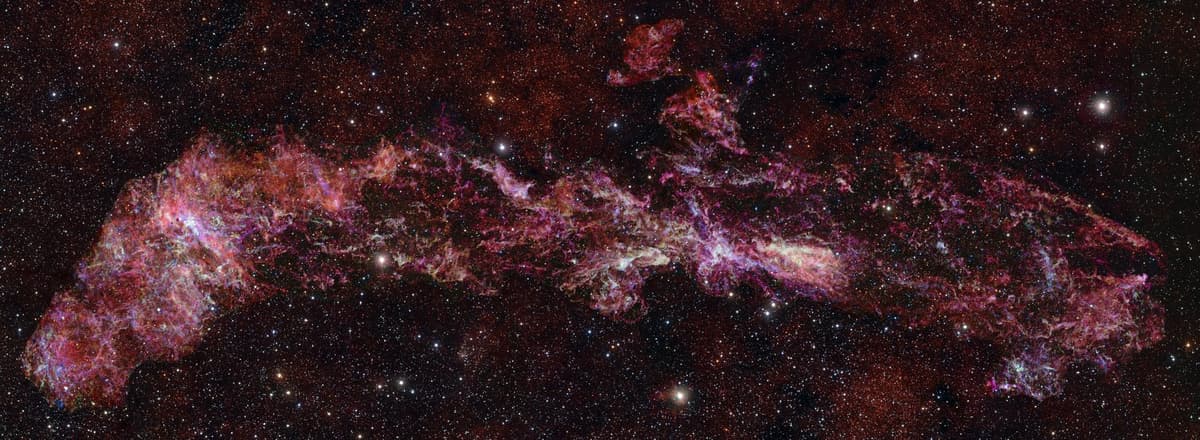
Astronomers Produce the Largest Image Ever Taken of the Heart of the Milky Way
•March 8, 2026
0
Why It Matters
The high‑resolution view of the Galactic Center provides critical data on how stars form under extreme conditions, directly informing theories of galaxy growth and the chemistry that may seed life. This breakthrough also positions the Milky Way as a nearby laboratory for studying processes that shaped the early universe.
Key Takeaways
- •ALMA captured 650‑light‑year image of Galactic Center
- •Mosaic spans area equal to three full moons
- •Survey maps dense gas filaments feeding star‑forming clumps
- •Data reveals complex organic molecules in Central Molecular Zone
- •Findings aid models of extreme star formation and early galaxies
Pulse Analysis
Radio astronomy has long been the key to peering through the dust that blinds optical telescopes, and ALMA’s unprecedented sensitivity makes it the premier instrument for such work. By stitching together thousands of pointings, the ACES team generated a mosaic that not only dwarfs previous Milky Way maps but also resolves structures from dozens of light‑years down to individual protostellar clouds. This level of detail transforms the Central Molecular Zone from a blurry silhouette into a richly textured laboratory, revealing how cold molecular gas organizes itself in the galaxy’s most turbulent heart.
The scientific payoff extends far beyond a pretty picture. The CMZ hosts some of the most massive, short‑lived stars in the Milky Way, and its chemistry includes both simple diatomic species and complex organics that hint at prebiotic pathways. By comparing these extreme conditions with those in the outer disk, astronomers can test whether conventional star‑formation models hold when pressure, turbulence, and radiation are amplified. Moreover, the Galactic Center serves as a nearby analog for the chaotic nuclei of early‑universe galaxies, offering clues about how the first generations of stars and black holes co‑evolved.
Looking ahead, the upcoming ALMA Wideband Sensitivity Upgrade and the commissioning of ESO’s Extremely Large Telescope will push resolution and spectral coverage even further. Researchers anticipate mapping finer filaments, tracing rarer molecules, and linking gas dynamics directly to black‑hole activity. The open‑access nature of the ACES dataset invites cross‑disciplinary collaboration, from astrochemistry to cosmology, ensuring that this landmark image will seed discoveries for years to come.
Astronomers Produce the Largest Image Ever Taken of the Heart of the Milky Way
0
Comments
Want to join the conversation?
Loading comments...