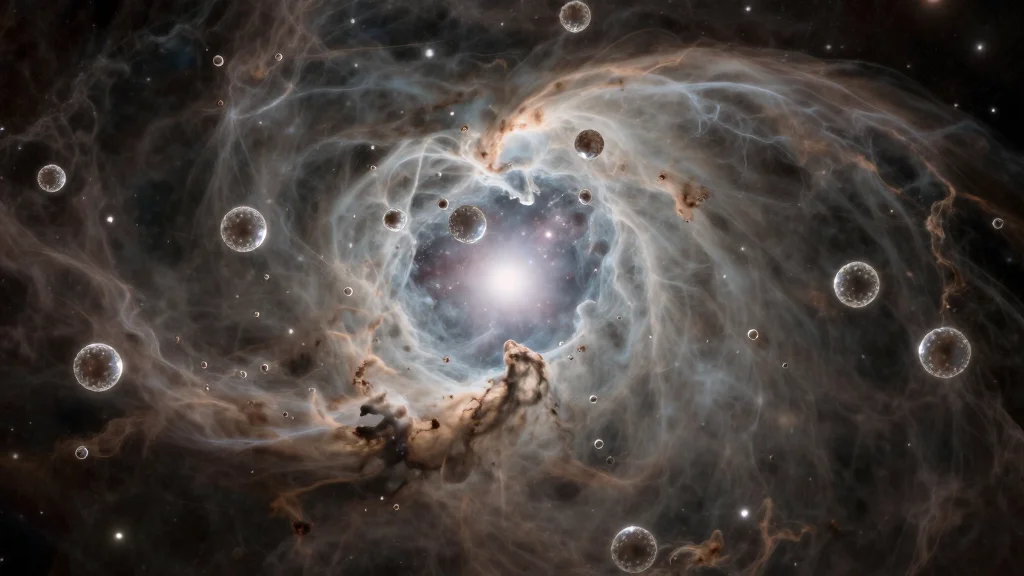
Astronomers Reveal Spectacular Birthplace of Cosmic Buckyballs
Why It Matters
The finding shows that complex carbon structures can arise naturally in stellar outflows, informing models of cosmic chemistry and the origins of pre‑biotic molecules that seed planetary systems.
Key Takeaways
- •JWST detected C₆₀ infrared fingerprints in nebula IRAS 21282+5050
- •Fullerenes form in carbon‑rich stellar winds, not just laboratory conditions
- •Estimated billions of kilograms of buckyballs produced galaxy‑wide annually
- •Discovery links interstellar chemistry to potential pre‑biotic pathways
- •Spectroscopy confirms fullerenes’ stability in harsh radiation fields
Pulse Analysis
The James Webb Space Telescope’s latest spectroscopic campaign has turned a long‑standing mystery into a concrete observation: the formation of buckyballs, or C₆₀ fullerenes, in a real astrophysical setting. By targeting the carbon‑rich planetary nebula IRAS 21282+5050, JWST’s NIRSpec instrument captured distinct infrared emission bands that match laboratory signatures of spherical carbon molecules. This breakthrough validates theoretical predictions that fullerenes can condense in the cooling outflows of dying stars, where carbon atoms aggregate under intense radiation and shock conditions.
Beyond the novelty of spotting a molecule famously associated with nanotechnology, the discovery reshapes our understanding of organic synthesis across the cosmos. Fullerenes are exceptionally stable, resisting fragmentation by ultraviolet photons and cosmic rays. Their presence implies that other complex organics—potential precursors to amino acids and nucleobases—could survive the journey from stellar nurseries to nascent planetary disks. If billions of kilograms of buckyballs are produced galaxy‑wide each year, as the authors estimate, they may serve as carriers of carbon-rich material, seeding young worlds with the building blocks of life.
For the broader scientific and commercial sectors, the implications are twofold. First, astrochemical models must now incorporate fullerene formation pathways, affecting predictions of dust grain composition and infrared background radiation. Second, the detection showcases JWST’s capability to probe molecular complexity at unprecedented sensitivity, opening avenues for future missions targeting pre‑biotic chemistry in exoplanet atmospheres. As the field moves toward linking interstellar chemistry with habitability, the buckyball discovery stands as a pivotal data point that bridges laboratory nanoscience and cosmic evolution.
Astronomers Reveal Spectacular Birthplace of Cosmic Buckyballs
Comments
Want to join the conversation?
Loading comments...