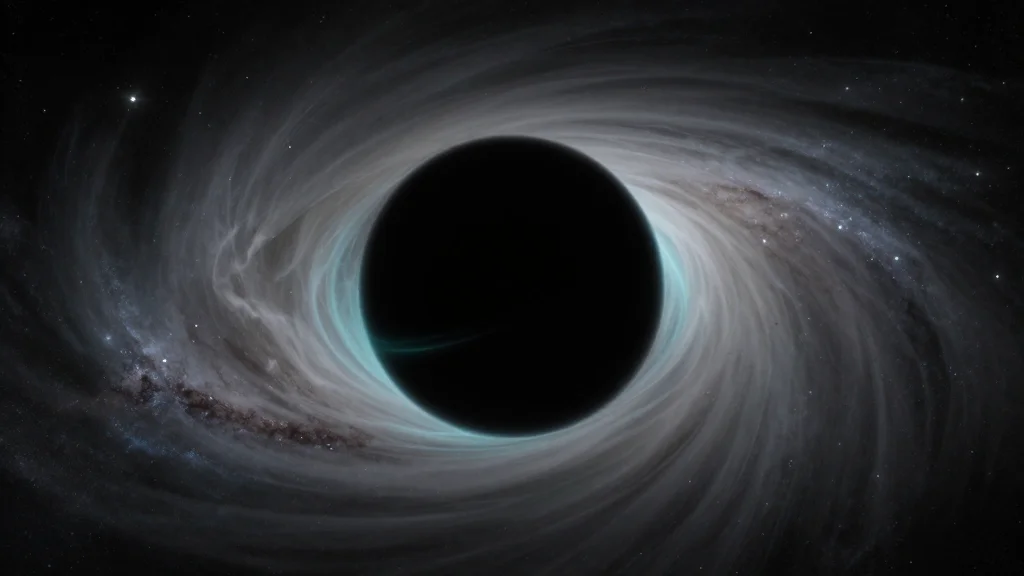
Astronomers Spot First ‘Gentle Breeze’ From Milky Way’s Central Black Hole

Why It Matters
Detecting a black‑hole‑driven wind in our own galaxy provides a crucial benchmark for astrophysical models that link black hole activity to galaxy‑scale processes. It confirms that even low‑luminosity black holes can influence their environments, offering a missing piece in the puzzle of how galaxies regulate star formation over billions of years. The discovery also validates the power of high‑resolution radio interferometry to pierce the dense veil of the galactic centre, opening a new observational window for future studies of black hole feedback. Beyond the Milky Way, the result may prompt a reassessment of the prevalence of subtle outflows in other quiescent galaxies. If gentle breezes are common, they could represent a pervasive, yet previously undetected, mode of black hole feedback that shapes the evolution of many galaxies without the dramatic signatures of powerful jets or radiation‑driven winds.
Key Takeaways
- •Astronomers detected a cone‑shaped gas outflow from Sagittarius A* using 100 hours of ALMA data.
- •The wind consists of hot ionised gas, replacing cold carbon‑monoxide in a region 80× sharper than prior images.
- •First direct evidence of black‑hole‑driven winds in the Milky Way after 50 years of searching.
- •Findings suggest even a quiet supermassive black hole can affect star formation by heating surrounding gas.
- •Future observations with ALMA and JWST will probe the wind’s composition and impact on the galactic halo.
Pulse Analysis
The breakthrough underscores a shift in how the astronomical community views black hole feedback. For decades, the narrative has been dominated by extreme, high‑energy outflows observed in distant quasars, which are easy to spot but represent a minority of black holes. This detection of a low‑velocity, thermally driven wind from a dormant nucleus forces theorists to incorporate a continuum of feedback strengths into galaxy evolution simulations. Historically, models have struggled to reconcile the modest star‑formation rates of the Milky Way with the absence of strong AGN activity; the gentle breeze provides a plausible, continuous throttling mechanism.
From a methodological standpoint, the success of the ALMA campaign illustrates the growing importance of long‑baseline, high‑sensitivity radio observations in tackling problems once thought to be the domain of optical or X‑ray telescopes. The 80‑fold improvement in spatial resolution allowed researchers to isolate the wind’s signature from the chaotic backdrop of the galactic centre. As facilities like the Next Generation VLA come online, we can expect a surge in similar high‑precision studies, potentially revealing a hidden population of weak outflows across the local universe.
Looking ahead, the discovery may influence funding priorities. Agencies could allocate more resources to deep, targeted surveys of nearby galactic nuclei, seeking to map the prevalence and energetics of these subtle winds. If subsequent observations confirm that such breezes are common, they could become a key parameter in the next generation of cosmological models, refining our understanding of how galaxies like our own maintain the delicate balance between gas inflow, star formation, and black hole growth.
Astronomers Spot First ‘Gentle Breeze’ From Milky Way’s Central Black Hole
Comments
Want to join the conversation?
Loading comments...