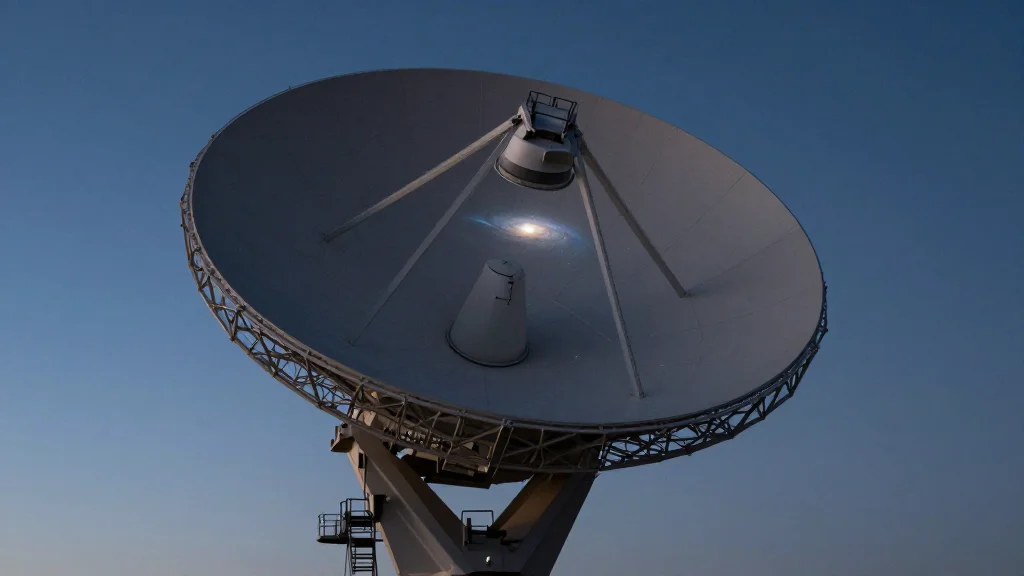
Astronomers Spot Record-Breaking Gigamaser 8 Billion Light‑Years Away

Why It Matters
The detection of a gigamaser at such a distance provides a novel diagnostic for the physical conditions inside merging galaxies when the universe was half its current age. By leveraging natural amplification mechanisms—both maser action and gravitational lensing—researchers gain access to molecular processes that are otherwise invisible, offering a fresh avenue to test theories of star formation and black‑hole fueling in the early universe. Moreover, the ability to capture such a bright, narrow signal in a few hours suggests that future radio facilities can systematically hunt for similar beacons, potentially turning gigamasers into a new class of cosmological probes. Beyond pure astrophysics, the discovery underscores the power of international radio infrastructure. MeerKAT’s performance demonstrates that existing mid‑size arrays can deliver breakthrough science, informing investment decisions for the upcoming Square Kilometre Array. The result is a compelling case for expanding high‑sensitivity, wide‑field radio surveys, which could reshape our picture of galaxy evolution and the distribution of matter across billions of years.
Key Takeaways
- •MeerKAT detected a hydroxyl gigamaser from galaxy HATLAS J142935.3–002836 at redshift ~1.027 (≈8 billion light‑years).
- •Signal‑to‑noise ratio exceeded 150 in under five hours of observation.
- •Gravitational lensing amplified the beam, enabling detection of a source otherwise too faint.
- •Emission observed at 1665 and 1667 MHz, with luminosity comparable to the Sun’s total output if concentrated in a line.
- •Detection hints at a larger, hidden population of energetic galaxy mergers accessible to future radio surveys.
Pulse Analysis
The gigamaser discovery is a textbook example of how serendipitous astrophysical phenomena can turn a modest instrument into a discovery engine. Historically, megamasers have been used to map the dynamics of nearby active galaxies, but their utility at cosmological distances has been limited by sensitivity and beam smearing. By catching a source that benefits from both intrinsic maser amplification and extrinsic gravitational lensing, the MeerKAT team has effectively bypassed those constraints. This dual‑boost strategy could become a template for future searches: identify lensing fields, then scan for narrow‑band spikes that betray maser activity.
From a competitive standpoint, the result puts South Africa’s radio astronomy infrastructure in direct conversation with the upcoming Square Kilometre Array (SKA). While the SKA will dwarf MeerKAT in collecting area, the current finding proves that strategic, targeted observations can yield high‑impact science even before the SKA comes online. It also pressures other facilities—such as the Very Large Array and the upcoming ngVLA—to prioritize high‑spectral‑resolution, wide‑field surveys that can capture similar transient, narrow‑band phenomena.
Looking ahead, the real test will be whether gigamasers can be standardized enough to serve as cosmological distance markers or as tracers of merger rates across epochs. If a statistically significant sample emerges, they could complement Type Ia supernovae and baryon acoustic oscillations, offering an independent check on dark energy models. For now, the discovery is a reminder that the universe still hides luminous signposts, waiting for the right combination of physics and geometry to bring them into view.
Astronomers Spot Record-Breaking Gigamaser 8 Billion Light‑Years Away
Comments
Want to join the conversation?
Loading comments...