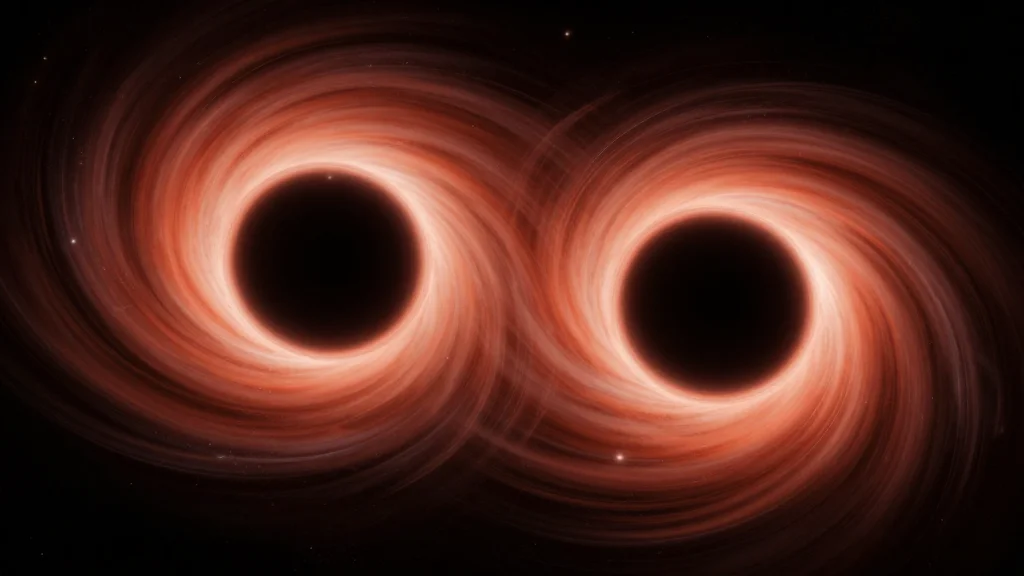
Astronomers Spot Record‑Breaking Supermassive Black Hole Binary 4.4 Billion Light‑Years Away

Why It Matters
The identification of the most massive supermassive black‑hole binary to date forces a reassessment of how quickly black holes can grow in the early universe. If such massive pairs can form within a few billion years, existing models of galaxy evolution and black‑hole seed formation may require substantial revision. Moreover, the system offers a rare laboratory for testing general relativity in the strong‑field regime and for probing the environments of merging galaxies. Beyond theory, the discovery highlights the power of coordinated, multi‑telescope observations to push the frontiers of astrophysics. As next‑generation observatories come online, astronomers will be better equipped to locate and study similar extreme systems, potentially unlocking new insights into the role of black‑hole mergers in shaping cosmic structure.
Key Takeaways
- •Astronomers identified a supermassive black‑hole binary 4.4 billion light‑years away.
- •Each black hole is estimated to exceed several hundred million solar masses.
- •The pair may be the most massive binary ever observed, challenging formation models.
- •Mass estimates are based on indirect measurements; uncertainties remain.
- •Future observations with JWST and next‑gen radio arrays aim to confirm the discovery.
Pulse Analysis
The breakthrough underscores a shift in how the astronomical community approaches the hunt for extreme objects. Historically, supermassive black‑hole binaries have been elusive, with only a handful of candidates identified through indirect signatures such as periodic quasar light curves. This new detection, achieved through direct imaging of orbital motion, signals that the combination of high‑resolution interferometry and deep spectroscopic surveys is finally reaching the sensitivity needed to resolve these distant giants.
From a historical perspective, the field has wrestled with a paradox: simulations predict that massive black holes should merge early, yet observational evidence has lagged. The current find narrows that gap, suggesting that the universe may have been more efficient at building black‑hole mass than previously thought. If subsequent measurements confirm the extreme masses, theorists will need to explore mechanisms such as super‑Eddington accretion or rapid hierarchical merging to reconcile the data.
Looking ahead, the discovery could catalyze a new wave of targeted searches. With the upcoming launch of the Laser Interferometer Space Antenna (LISA) slated for the 2030s, astronomers anticipate detecting the low‑frequency gravitational waves emitted by such massive binaries. The present system could become a benchmark source for calibrating LISA’s sensitivity, linking electromagnetic observations with gravitational‑wave data and ushering in a truly multi‑messenger era for black‑hole astrophysics.
Astronomers Spot Record‑Breaking Supermassive Black Hole Binary 4.4 Billion Light‑Years Away
Comments
Want to join the conversation?
Loading comments...