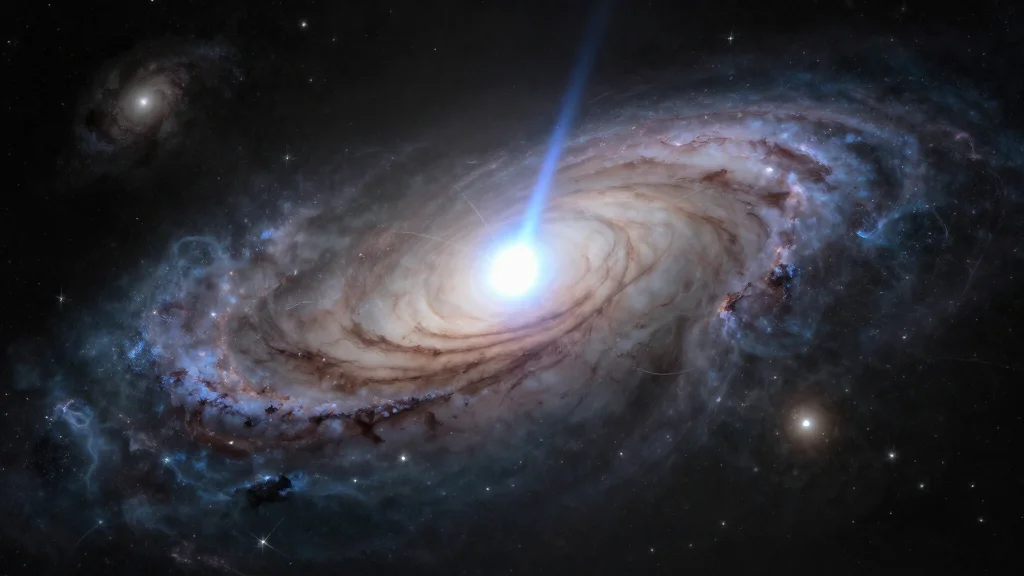
Astronomers Uncover Statistical Evidence for Recoiling Supermassive Black Holes
Why It Matters
The finding provides a practical observational handle on SMBH recoil, sharpening predictions for next‑generation gravitational‑wave detectors and deepening our understanding of galaxy evolution after mergers.
Key Takeaways
- •Positive correlation between quasar velocity offset and surrounding dust
- •Broad Line Region shifts reveal black hole recoil speeds
- •Study suggests up to 50% of quasars stem from recent mergers
- •Blue‑shifted black holes appear more dust‑obscured, contrary to expectations
- •Findings aid future LISA gravitational‑wave observations
Pulse Analysis
The merger of two supermassive black holes is one of the most energetic events in the universe, releasing gravitational waves that can impart a powerful kick to the newly formed remnant. General relativity predicts that asymmetries in spin or mass cause the merged black hole to recoil at velocities ranging from a few hundred to several thousand kilometres per second. Such kicks can displace the black hole from the galactic nucleus, potentially altering the host galaxy’s central dynamics and influencing star formation patterns. Understanding these recoils is essential for building accurate models of galaxy growth and black‑hole demographics.
In the new study, researchers leveraged a long‑standing theoretical prediction that a recoiling SMBH drags its tightly bound inner accretion disk while leaving more extended dust clouds behind. By measuring the wavelength shift between the Broad Line Region—tied to the moving black hole—and the stationary Narrow Line Region, they derived velocity offsets for a large quasar sample. A statistically significant positive correlation emerged between these offsets and the amount of dust obscuring each quasar, confirming the expected relationship. The surprising excess of dust around blue‑shifted objects hints at subtle biases in spectral fitting or additional physical processes that merit further investigation.
The implications extend far beyond academic curiosity. If up to half of the observable quasar population indeed traces recent black‑hole mergers, space‑based gravitational‑wave observatories like ESA’s LISA will have a rich catalog of electromagnetic counterparts to target. Coordinated observations could pinpoint recoil events, refine merger rate estimates, and test general‑relativity predictions in the strong‑field regime. Moreover, mapping displaced SMBHs will illuminate how galactic cores recover after violent mergers, offering new insights into the co‑evolution of galaxies and their central black holes.
Astronomers uncover statistical evidence for recoiling supermassive black holes
Comments
Want to join the conversation?
Loading comments...