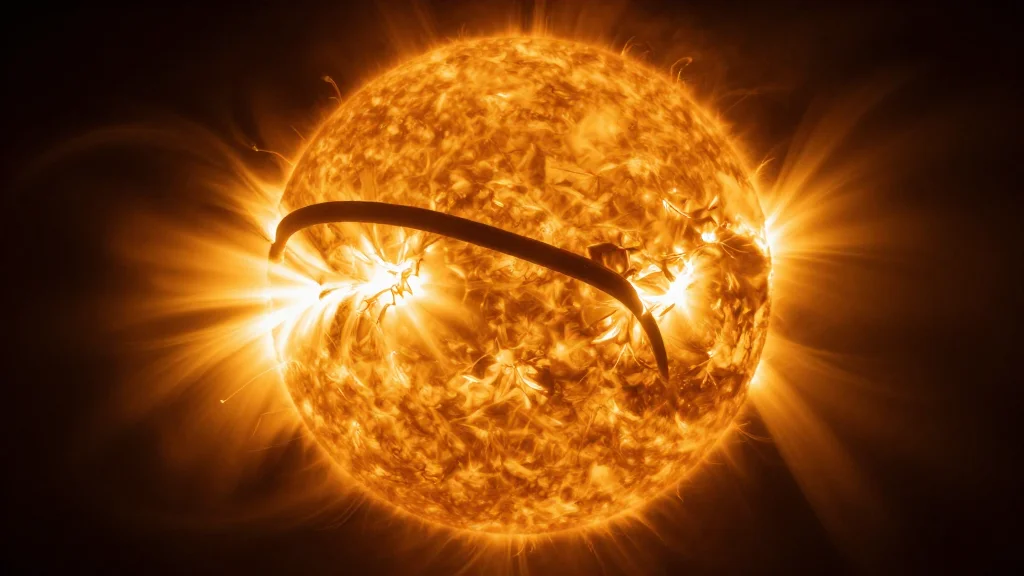
Astronomers Uncover Why Some Solar Eruptions Die
Why It Matters
Understanding why some eruptions die improves prediction of geomagnetic storms, protecting satellites, communications and power‑grid infrastructure. The findings give forecasters a new diagnostic to assess eruption likelihood, reducing economic risk from space‑weather events.
Key Takeaways
- •Failed eruptions tied to overlying magnetic field strength
- •Study examined 45 flare events with SDO data
- •Strong magnetic arches trap plasma, preventing CME
- •Results enhance space‑weather prediction models
- •Helps safeguard satellites and power‑grid operations
Pulse Analysis
Solar eruptions, or coronal mass ejections (CMEs), are massive bursts of plasma that can travel billions of miles, potentially disrupting Earth’s magnetosphere. While most CMEs escape the Sun’s gravity, a significant minority stall and collapse back onto the solar surface, a phenomenon long observed but poorly understood. The new Harvard‑CFA study leverages the Solar Dynamics Observatory’s continuous imaging to dissect the magnetic architecture surrounding these eruptions, revealing that a robust, closed magnetic canopy can act like a cage, halting the outward momentum of the plasma. This mechanistic insight bridges a gap in solar physics, offering a concrete parameter—magnetic field strength—that can be quantified in real time.
The practical implications extend far beyond academic curiosity. Space‑weather agencies such as NOAA’s Space Weather Prediction Center rely on CME forecasts to issue alerts for airlines, satellite operators, and utility companies. By incorporating the magnetic confinement metric into predictive algorithms, forecasters can more accurately distinguish between eruptions that will impact Earth and those that will not, reducing false alarms and allowing resources to be allocated more efficiently. This refinement is especially critical as the global economy becomes increasingly dependent on satellite‑based services and as power‑grid operators seek to harden infrastructure against geomagnetic induced currents.
Looking ahead, the study’s methodology sets a precedent for integrating high‑resolution solar imaging with advanced magnetohydrodynamic modeling. As next‑generation observatories like the Parker Solar Probe and the European Solar Orbiter deliver even richer datasets, the magnetic‑field‑based criteria identified here can be calibrated across a broader range of solar conditions. Ultimately, this research not only deepens scientific understanding of solar dynamics but also underpins the resilience of modern technological systems against the Sun’s most volatile outbursts.
Astronomers Uncover Why Some Solar Eruptions Die
Comments
Want to join the conversation?
Loading comments...