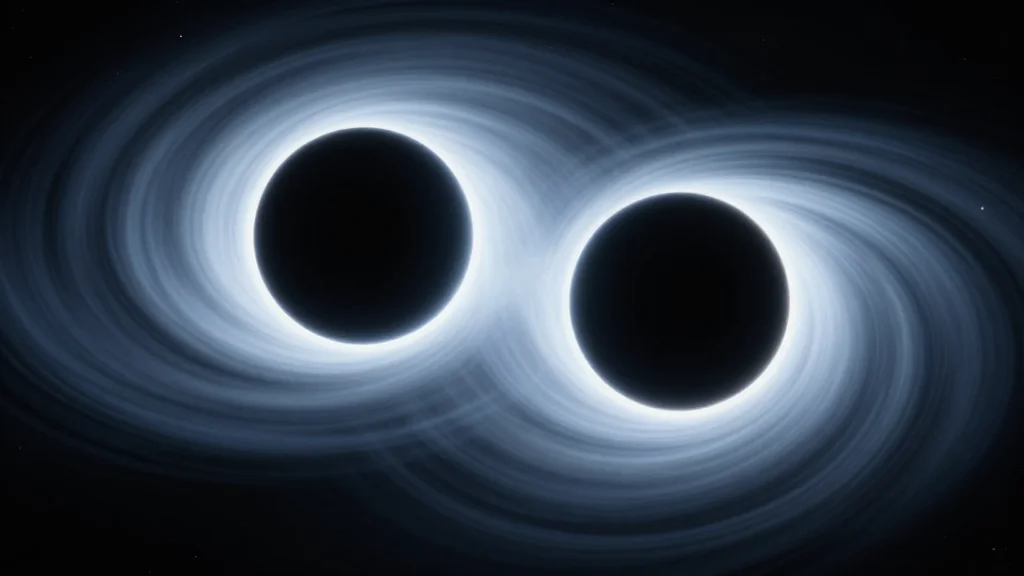
Astrophysicists Strike Black Gold with Treasure Trove of Gravitational Wave Detections
Why It Matters
The surge in high‑quality detections transforms gravitational waves into a precision tool for testing fundamental physics and refining cosmological parameters, accelerating the transition from discovery to routine astrophysical measurement.
Key Takeaways
- •GWTC‑5.0 adds 161 black‑hole mergers, total 390 detections.
- •Record sky localisation: 6 square degrees for GW240615.
- •Clearest signal GW250114 reaches SNR 76.9, tests GR.
- •Second‑generation black holes identified via high spins.
- •Expanded catalog improves Hubble constant precision with 236 signals.
Pulse Analysis
The release of GWTC‑5.0 marks a watershed moment for gravitational‑wave astronomy, reflecting a decade of detector upgrades and algorithmic advances. LIGO, Virgo, and KAGRA now capture three to four events per week, a cadence that would have been unimaginable in 2015. This bounty of data not only expands the raw event count but also enriches the diversity of observed mergers, allowing scientists to probe subtle features such as spin orientations and mass distributions across hundreds of sources.
Among the catalog’s standout achievements are a record‑tight sky localisation of just six square degrees for the June 2024 event GW240615 and the unprecedented signal‑to‑noise ratio of 76.9 for GW250114. The former enables rapid electromagnetic follow‑up, while the latter provides a pristine laboratory for testing Einstein’s theory of general relativity and confirming Hawking’s black‑hole area theorem. Additionally, the identification of second‑generation black holes—objects formed from prior mergers—offers fresh insight into dense stellar environments and the hierarchical growth of compact objects.
Beyond astrophysics, the expanded dataset sharpens cosmological measurements, particularly the Hubble constant. By incorporating Virgo’s return to the network, researchers can pinpoint source locations more accurately, linking gravitational‑wave events to host galaxies and reducing distance uncertainties. The resulting 236‑event sample improves the precision of expansion‑rate estimates, narrowing the tension between early‑universe and late‑time measurements. As detector sensitivity climbs and analysis pipelines accelerate—now running a thousand times faster—the field is poised to deliver routine, high‑precision cosmology, attracting investment from both public and private sectors eager to harness this new observational frontier.
Astrophysicists strike black gold with treasure trove of gravitational wave detections
Comments
Want to join the conversation?
Loading comments...