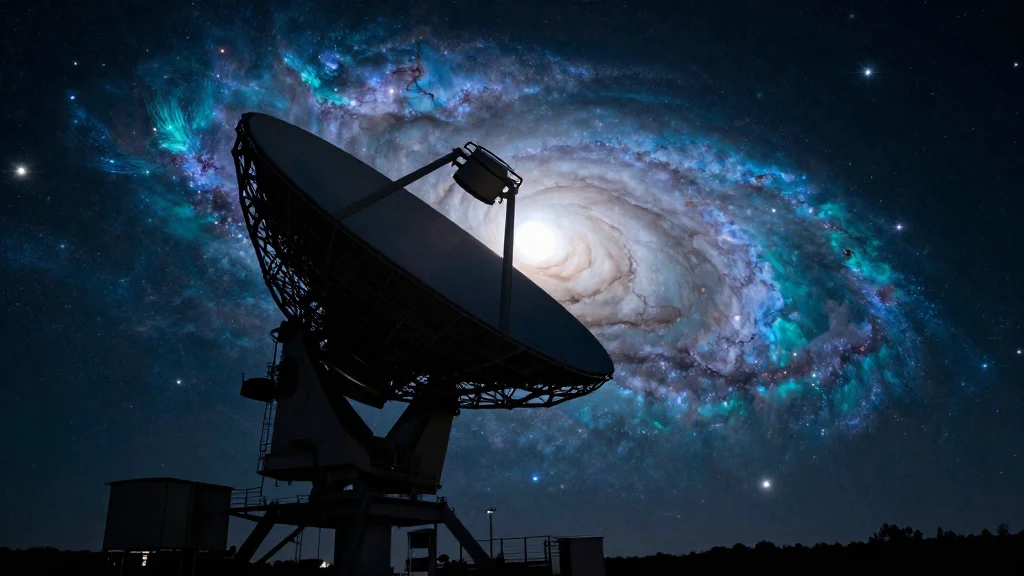
Astrophysicists Use 'Space Archaeology' To Trace the History of a Spiral Galaxy
Why It Matters
Understanding NGC 1365’s formation clarifies the processes that shape large spiral galaxies, informing models of element distribution and cosmic evolution. The findings also offer a benchmark for comparing our Milky Way’s history to other massive disks.
Key Takeaways
- •Mapped oxygen in thousands of NGC 1365 star‑forming clouds.
- •Matched observations to one of 20,000 simulated galaxies.
- •Central region enriched early; outer disk grew slowly via mergers.
- •Study pioneers “chemical archaeology” for galaxies beyond the Milky Way.
- •Findings challenge assumptions about typical spiral galaxy growth patterns.
Pulse Analysis
Galaxy evolution researchers have long relied on broad statistical surveys, but the recent NGC 1365 study showcases the power of high‑resolution chemical mapping to decode individual histories. By charting oxygen abundance—a tracer of stellar nucleosynthesis—across the galaxy’s disk, scientists obtained a spatially resolved timeline of star formation and enrichment. This granular view complements large‑scale surveys, offering a template for how localized chemical signatures can reveal the sequence of gas inflows, starbursts, and merger events that shape massive spirals.
The team leveraged the du Pont telescope’s spectroscopic capabilities to capture emission lines from thousands of H II regions, then fed these measurements into a library of 20,000 cosmological simulations. Selecting the model that best reproduced the observed metallicity gradients allowed them to rewind the galaxy’s growth, pinpointing an early‑formed, oxygen‑rich core and a later‑accreted outer disk. This methodology—dubbed “chemical archaeology”—bridges observational astronomy and theoretical modeling, delivering a reproducible framework that can be applied to other nearby galaxies with sufficient spectroscopic data.
Implications extend beyond a single case study. By establishing that massive spirals may build their bulges quickly while assembling disks over extended periods, the work challenges the conventional view that disk growth is uniformly gradual. It also provides a comparative baseline for the Milky Way, whose own chemical evolution can now be examined against NGC 1365’s timeline. Future research will test whether this pattern holds across diverse environments, refining our understanding of how gas inflow, mergers, and feedback collectively drive the cosmic life cycles of galaxies.
Astrophysicists use 'space archaeology' to trace the history of a spiral galaxy
Comments
Want to join the conversation?
Loading comments...