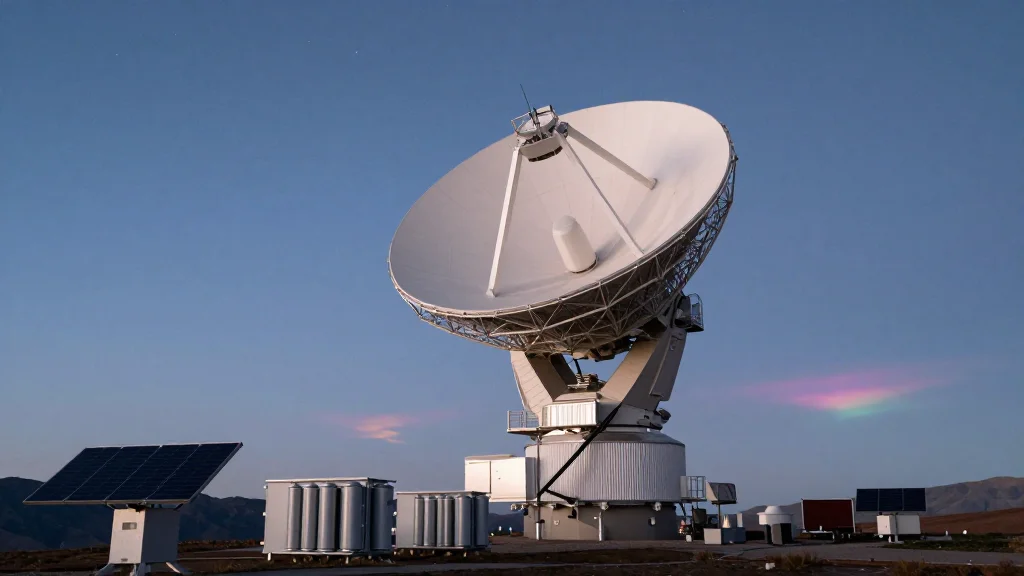
AtLAST, a Telescope that Could Reveal the Missing Half of the Universe
Why It Matters
AtLAST will close a critical observational gap, allowing astronomers to quantify the universe’s hidden matter and advance models of galaxy evolution, dark matter and dark energy. Its carbon‑neutral design also sets a new sustainability benchmark for large scientific infrastructure.
Key Takeaways
- •AtLAST will map dust‑obscured galaxies across the sky
- •50‑metre dish powered entirely by renewable energy sources
- •Survey could uncover up to 50 million hidden galaxies in 1,000 hours
- •Design emphasizes 50‑year lifespan and upgradeable instrumentation
Pulse Analysis
The submillimeter window has become indispensable for probing the cold, dust‑laden regions where stars and galaxies form, yet existing facilities such as ALMA operate like microscopes, covering only tiny patches of sky. AtLAST, a 50‑metre single‑dish telescope slated for the Atacama Desert, will flip that paradigm by delivering a wide‑angle view comparable to sixteen lunar disks in a single exposure. This leap in field‑of‑view will enable astronomers to conduct all‑sky surveys of molecular gas and dust, filling a critical gap before the next generation of giant observatories comes online in the 2040s.
Beyond its scientific reach, AtLAST is being engineered as a carbon‑neutral observatory. The 4,400‑tonne structure will draw power from a hybrid system of solar panels, battery banks and metal‑hydride storage, while regenerative braking recovers kinetic energy during dish repositioning. Designers are also exploring near‑zero‑carbon production for the aluminum panels and steel framework, setting a precedent for future large‑scale facilities. By proving that a 50‑metre telescope can operate without fossil fuels, the project aligns with Europe’s climate commitments and could reshape funding models for astronomical infrastructure.
The scientific payoff promises to rewrite our picture of the hidden universe. With the ability to detect cold gas and dust across billions of light‑years, AtLAST could catalog up to 50 million previously unseen galaxies, refine measurements of dark‑matter distribution, and tighten constraints on dark‑energy driven expansion. Its sensitivity to complex molecules also opens a new avenue for astrobiology, searching for pre‑biotic chemistry in distant star‑forming clouds. Designed for a 50‑year operational life and modular upgrades, the telescope will serve multiple generations, ensuring that unexpected transient phenomena at submillimeter wavelengths are captured long after its initial surveys.
AtLAST, a telescope that could reveal the missing half of the universe
Comments
Want to join the conversation?
Loading comments...