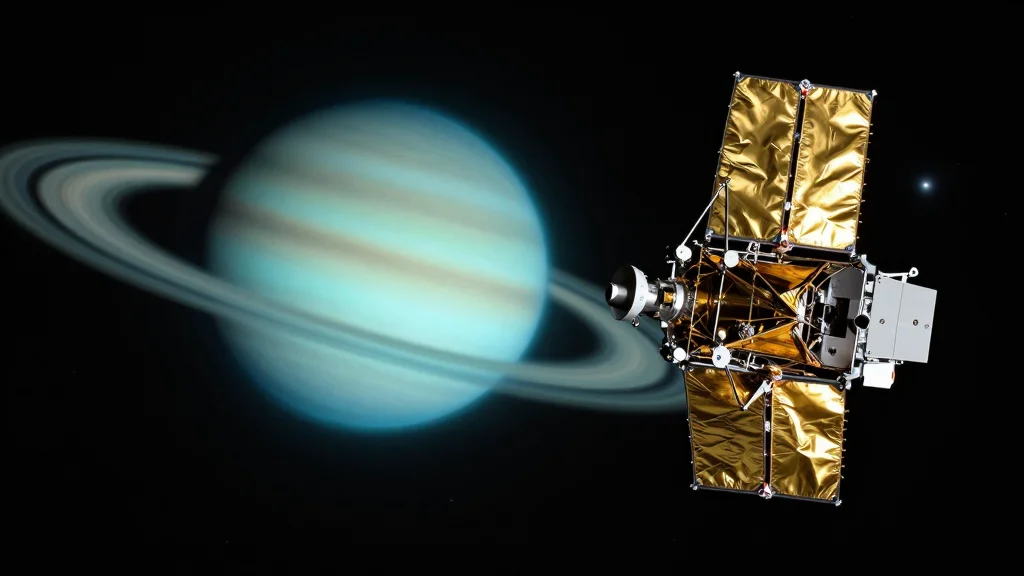
Atmosphere of Saturn-Sized Planet with Earth-Like Temperature Contains Methane
Why It Matters
The discovery shows that temperate, methane‑rich atmospheres can exist on large exoplanets, expanding the range of worlds considered for future biosignature searches. It also validates JWST’s capability to characterize atmospheres beyond Earth‑sized planets.
Key Takeaways
- •Saturn‑sized exoplanet shows Earth‑like temperature (~288 K)
- •Methane detected alongside water vapor and carbon dioxide
- •Atmospheric composition hints at active photochemistry
- •Finding widens habitability criteria beyond rocky planets
- •JWST proves effective for large‑planet atmospheric studies
Pulse Analysis
The detection of methane on a temperate, Saturn‑sized exoplanet marks a milestone in exoplanetary science. Using the James Webb Space Telescope’s near‑infrared spectrograph, researchers captured the planet’s transmission spectrum during multiple transits, revealing distinct absorption features of methane, water vapor, and carbon dioxide. This combination of gases suggests a chemically active atmosphere where photochemical processes could be reshaping molecular abundances, a scenario previously thought to be limited to smaller, rocky worlds. The planet’s equilibrium temperature, estimated at roughly 288 K (15 °C), mirrors Earth’s average, challenging the conventional view that gas giants are too hot or too cold to host Earth‑like conditions.
Beyond the immediate scientific intrigue, the finding has broader implications for the search for life beyond the Solar System. Methane is a potential biosignature when found in disequilibrium with carbon dioxide, especially on planets with temperate climates. While the presence of methane alone does not confirm biological activity, its coexistence with water vapor on a planet of this size suggests that complex atmospheric dynamics can sustain molecules that, on Earth, are linked to biological processes. This expands the target pool for future missions, encouraging astronomers to include larger, cooler gas giants in habitability assessments and to refine models that predict atmospheric chemistry under diverse stellar irradiance.
The success of JWST in characterizing a non‑Earth‑sized world underscores the telescope’s transformative role in exoplanet research. As the observatory continues to collect high‑resolution spectra, scientists anticipate a surge in detections of trace gases across a variety of planetary classes. These data will feed into next‑generation atmospheric models, improve our understanding of planet formation, and guide the design of upcoming missions—such as the Habitable Worlds Observatory—aimed at directly imaging and probing the atmospheres of potentially habitable exoplanets. The methane discovery thus not only enriches our knowledge of planetary diversity but also sets a new benchmark for what is observationally achievable in the quest to find life beyond Earth.
Atmosphere of Saturn-Sized Planet with Earth-Like Temperature Contains Methane
Comments
Want to join the conversation?
Loading comments...