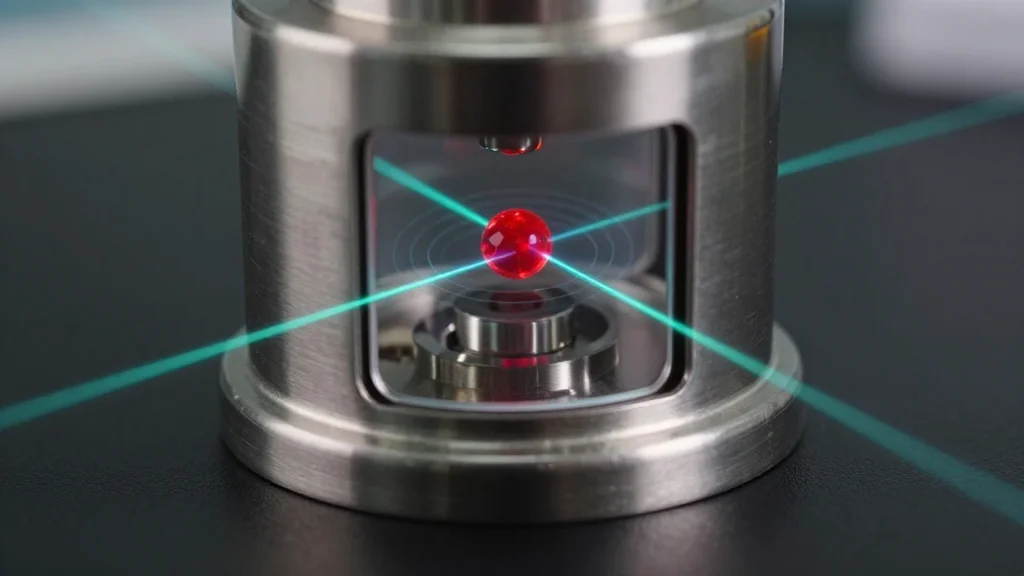
'Atom Camera' Maps Laser Light at Nanoscale Using a Single Ultracold Atom
Why It Matters
Accurate, nanoscale characterization of laser fields is essential for scaling neutral‑atom quantum computers, where qubit performance hinges on both intensity and polarization. The Atom Camera offers a non‑invasive way to verify and tune these fields, reducing error sources and accelerating quantum hardware development.
Key Takeaways
- •Atom Camera achieves ~25 nm positional precision, sub‑100 nm resolution
- •Uses single ultracold rubidium atom in optical tweezer as probe
- •Simultaneously maps light intensity and polarization at nanoscale
- •Enables in‑vacuum diagnostics for neutral‑atom quantum computers
- •Published in Nature Communications, advancing quantum‑device metrology
Pulse Analysis
Quantum technologies such as neutral‑atom quantum computers rely on tightly controlled laser fields to manipulate qubits. Traditional imaging methods struggle to resolve the sub‑micron intensity and polarization structures inside vacuum chambers, often introducing aberrations or perturbing the delicate quantum states. The Atom Camera addresses this gap by turning a single ultracold rubidium atom into a scanning probe, allowing researchers to directly measure the local electromagnetic environment without inserting bulky optics. This breakthrough aligns with the broader industry push for higher‑fidelity qubit control and error mitigation.
The core of the Atom Camera is an optical tweezer that holds the atom near absolute zero, minimizing its quantum‑mechanical motion to roughly 25 nm. As the atom traverses the light field, its internal spin states experience energy shifts proportional to both the light’s intensity and polarization. By recording these shifts across a nanometer‑scale grid, the system reconstructs detailed maps of the optical landscape, revealing features like non‑trivial circular polarization that emerge near focal points. The achieved resolution—well under 100 nm—surpasses the diffraction limit, offering a new level of insight into photonic structures that were previously invisible.
Beyond fundamental science, the Atom Camera holds practical implications for the rapidly expanding quantum‑computing market. Precise, in‑situ diagnostics enable engineers to fine‑tune laser lattices that trap and entangle atoms, directly improving gate fidelity and scaling prospects. Moreover, the technique could be adapted for other photonic platforms, such as integrated quantum photonics and advanced microscopy, where understanding nanoscale light behavior is crucial. As quantum hardware moves from laboratory prototypes to commercial systems, tools like the Atom Camera will become indispensable for quality control and performance optimization.
'Atom Camera' maps laser light at nanoscale using a single ultracold atom
Comments
Want to join the conversation?
Loading comments...