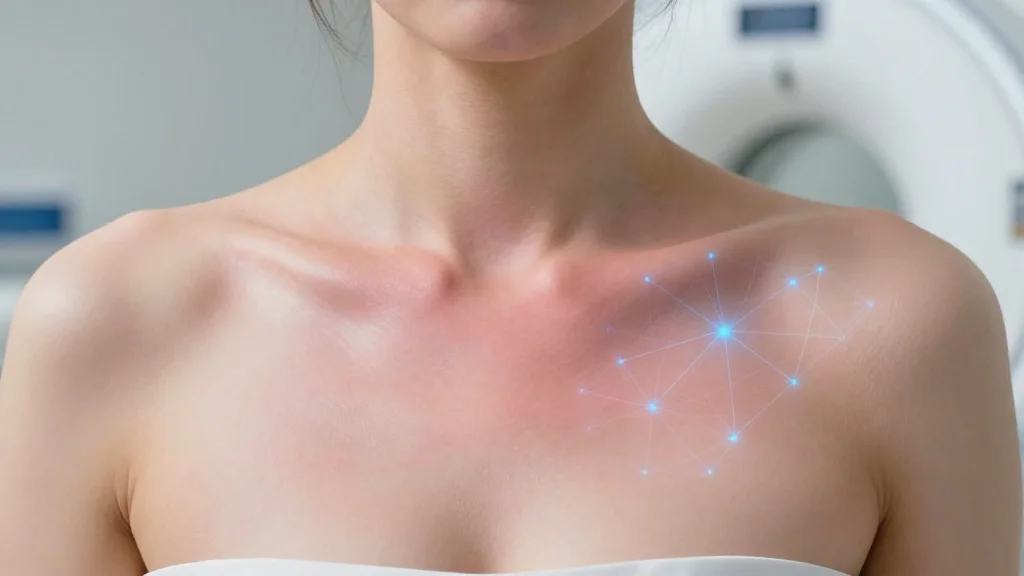
Automated Grading of Radiation Dermatitis in Breast Cancer Radiotherapy with Dual-Head Supervision and Rule-Based Fusion: A Multicenter Study
Why It Matters
Accurate, automated grading of radiation dermatitis can standardize assessments, reduce clinician workload, and enable timely interventions across oncology centers. Demonstrated cross‑center robustness positions the technology for broader clinical adoption.
Key Takeaways
- •Dual‑head model achieved 94.7% accuracy in internal validation.
- •External cohort accuracy remained above 90%, confirming robustness.
- •Rule‑based fusion outperformed single‑head configurations in ablation tests.
- •AI surpassed three clinicians, reaching 93.3% grading accuracy.
- •Model retained 89% accuracy on nasopharyngeal carcinoma images.
Pulse Analysis
Radiation dermatitis is a common, painful side effect of breast‑cancer radiotherapy, yet its severity is often assessed subjectively by clinicians. Inconsistent grading can delay appropriate skin care, affecting patient comfort and treatment continuity. Artificial intelligence offers a path to objective, reproducible evaluations, but prior models struggled with limited datasets and single‑task architectures, leading to variable performance across institutions.
The multicenter study leveraged over ten thousand prospectively captured skin photographs to train a dual‑head network that simultaneously performed categorical classification and ordinal regression. By integrating a rule‑based fusion layer, the system combined the strengths of both heads, delivering an internal accuracy of 94.7% and a quadratic weighted kappa of 0.958. Crucially, the model retained high performance in an independent external breast‑cancer cohort (90.9% accuracy) and demonstrated transferability to nasopharyngeal carcinoma patients, underscoring its generalizability across tumor sites and imaging conditions.
For oncology practices, the technology promises to streamline dermatitis monitoring, freeing clinicians to focus on treatment planning while ensuring patients receive prompt skin‑care interventions. The AI’s superiority over three experienced clinicians suggests a future where decision‑support tools augment dermatologic assessment, potentially lowering complication‑related costs. Continued validation in real‑world workflows and integration with electronic health records will be key to realizing these benefits and expanding AI‑driven diagnostics throughout radiation oncology.
Automated Grading of Radiation Dermatitis in Breast Cancer Radiotherapy with Dual-Head Supervision and Rule-Based Fusion: A Multicenter Study
Comments
Want to join the conversation?
Loading comments...