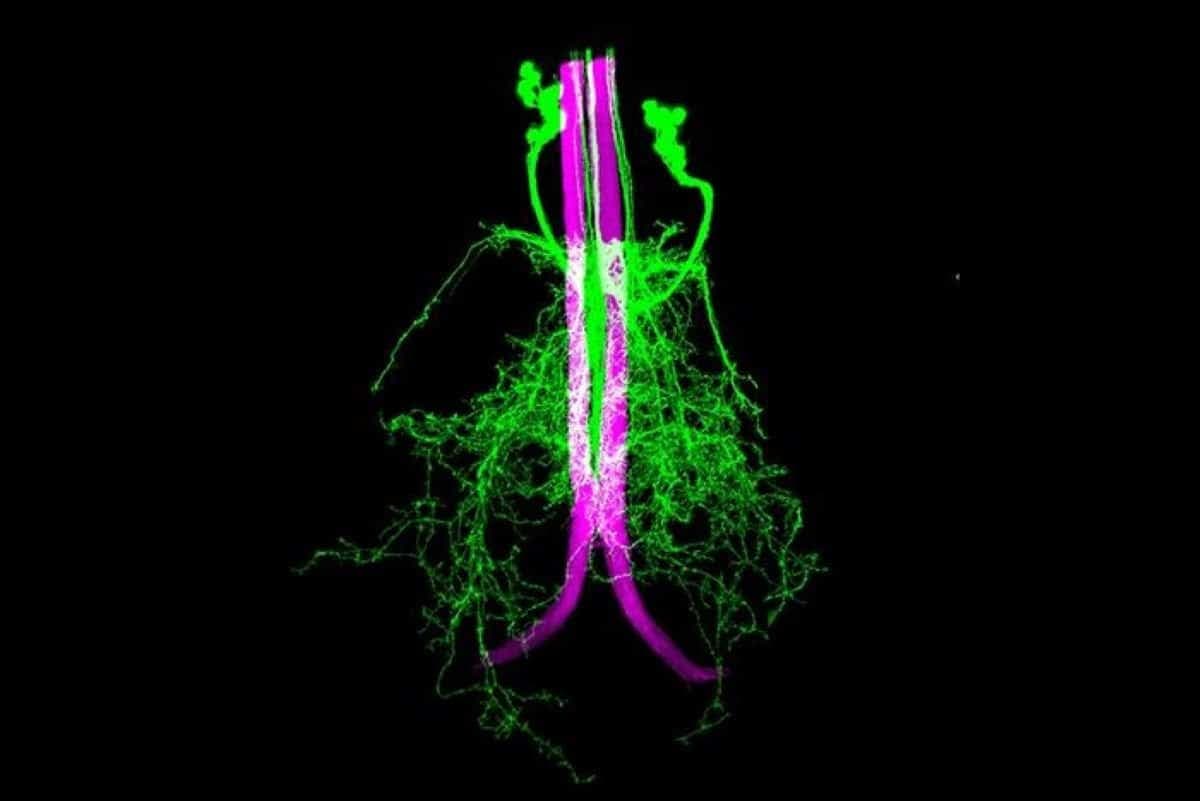
Axo-Axonic Synapses Drive Split-Second Fly Escape Reflexes
Why It Matters
The discovery shows how a minimal, decentralized circuit can generate lightning‑fast reflexes, offering a template for neuro‑engineered systems and deeper insight into rapid human motor control.
Key Takeaways
- •1,314 descending neurons mapped; axo‑axonic synapses found in ~1% pairings.
- •Axo‑axonic connections directly amplify giant‑fiber neurons, speeding escape responses.
- •Distributed “broker” network avoids single‑point failure, enhancing robustness.
- •Study offers blueprint for rapid motor control applicable to vertebrate systems.
Pulse Analysis
The fruit fly has long served as a premier model for neural circuit analysis, and the recent completion of its ventral nerve‑cord connectome provides an unprecedented wiring diagram. By systematically tracing every descending neuron, scientists identified a sparse but strategically placed set of axo‑axonic synapses—connections where one axon modulates another before the signal reaches muscles. This level of granularity, rarely achievable in larger brains, reveals how a handful of precise links can shape behavior without the overhead of massive, redundant pathways.
A key insight from the study is the emergence of a decentralized "broker" architecture. Rather than relying on a few dominant hub neurons, the fly’s escape circuitry distributes control across many axo‑axonic partners. This design confers resilience: damage to any single neuron does not cripple the reflex, and the network can dynamically synchronize spikes to ensure the giant‑fiber command fires reliably. Optogenetic experiments demonstrated that activating specific axo‑axonic neurons markedly raises the probability of a successful escape, confirming their functional potency.
Beyond entomology, the findings have broader relevance for neuroscience and bio‑inspired engineering. Axo‑axonic motifs exist in mammals, yet their system‑wide role remains obscure. The fly blueprint offers a testable model for how sparse, high‑gain connections can accelerate decision‑making in vertebrate motor systems, informing the design of rapid‑response prosthetics and autonomous robots. As researchers translate these principles, we may soon see new algorithms that mimic the fly’s split‑second reflexes to improve safety‑critical technologies.
Axo-Axonic Synapses Drive Split-Second Fly Escape Reflexes
Comments
Want to join the conversation?
Loading comments...