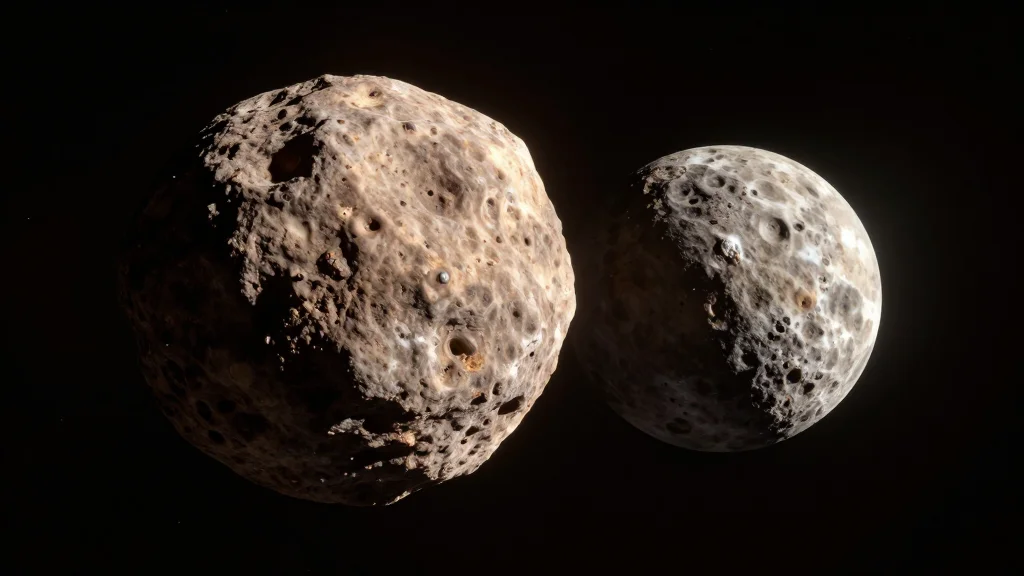
Binary Asteroids' Puzzling Configurations May Link to Multi-Satellite History
Why It Matters
Understanding multigenerational satellite dynamics reshapes models of asteroid evolution, informing planetary‑defense strategies and future resource‑extraction missions.
Key Takeaways
- •Lucy mission found Dinkinesh’s moon Selam is a contact binary.
- •Multiple shedding events create interaction regime causing satellite mergers.
- •~44% of binary asteroids show multigenerational satellite histories.
- •Orbital migration and tidal forces reshape asteroid moon orbits.
- •Triple systems like 2001 SN263 likely formed via similar interactions.
Pulse Analysis
The discovery of Selam, a double‑lobed moon around the tiny asteroid Dinkinesh, forced scientists to revisit the classic picture of binary asteroid formation. For decades, researchers assumed that rapid rotation of a parent body would fling debris that settles into a single satellite near the Roche limit. Lucy’s high‑resolution images, however, showed a moon far outside that zone, prompting a search for mechanisms that could generate such outliers. This puzzle sits at the intersection of planetary science and celestial mechanics, where subtle forces over millions of years can rewrite an asteroid’s family tree.
A team of dynamical astronomers tackled the problem with high‑fidelity N‑body simulations, revealing that rubble‑pile asteroids can undergo multiple, discrete mass‑shedding episodes throughout their lifespans. Each new fragment interacts gravitationally with any pre‑existing moons, whose orbits may have migrated due to tidal or thermal effects. When an older satellite resides at a medium distance, the system enters an "interaction regime" where newly born moons can be scattered, tidally disrupted, or merge at low velocity. These processes naturally produce contact‑binary moons like Selam and explain the diverse orbital architectures observed in triple systems such as 2001 SN263 and Balam.
The broader implications extend beyond academic curiosity. Recognizing that nearly half of binary asteroids likely experienced multigenerational satellite interactions reshapes risk assessments for potential Earth impactors, as complex moon systems can alter trajectory predictions. Moreover, the findings guide upcoming missions—China’s Tianwen‑2 to active asteroid 311P/PANSTARRS and future asteroid‑mining ventures—by highlighting regions where tidal disruption may expose fresh material. As the catalog of exotic binaries expands, industry and defense planners must incorporate these nuanced dynamical histories into their models.
Binary asteroids' puzzling configurations may link to multi-satellite history
Comments
Want to join the conversation?
Loading comments...