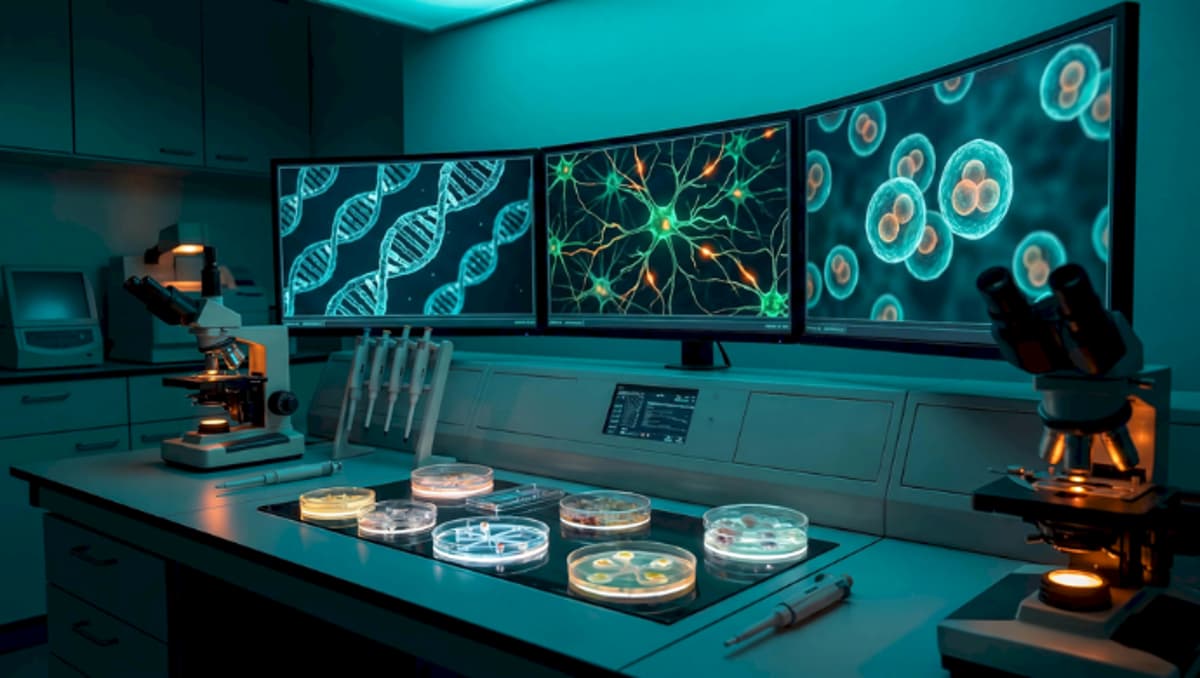
Biocomputing: The Race for Energy Efficiency, Storage Capacity, and Machine Sentience
Companies Mentioned
Why It Matters
DNA’s ultra‑dense archival potential could reshape long‑term data storage economics, while organoid intelligence may redefine low‑energy AI substrates if scalability challenges are solved.
Key Takeaways
- •DNA storage density reaches 17 exabytes per gram, but costs $800M/TB
- •DNA archival cost remains ~$122 per megabyte, far above tape
- •Organoid intelligence faces reproducibility and ethical oversight challenges
- •Neuromorphic chips like Intel Loihi 2 offer superior energy efficiency
- •US NSF allocated $14 million in 2024 for organoid research
Pulse Analysis
Biocomputing is emerging as a bifurcated field where biology augments traditional silicon. Molecular biocomputing leverages DNA’s molecular structure to achieve storage densities far beyond magnetic tape—up to 17 exabytes per gram in laboratory demonstrations. Yet the economics remain prohibitive, with estimates of $800 million per terabyte versus $15 per terabyte for tape, and recent advances only lowering write costs to about $122 per megabyte. The technology is therefore best suited for the deepest archival tier, where durability and migration costs outweigh per‑byte expense, and it aligns with industry initiatives such as the DNA Data Storage Alliance that aim to standardise codecs and bio‑security protocols.
Neural biocomputing, epitomised by organoid intelligence, seeks to harness living neural networks as adaptive computational substrates. While organoids can perform reservoir‑computing tasks and have attracted $14 million from the US National Science Foundation, they face steep hurdles: batch‑to‑batch variability, stringent incubation requirements, and unresolved ethical questions about consciousness. Moreover, when measured against emerging neuromorphic hardware—Intel’s Loihi 2 promises a hundred‑fold energy reduction compared with conventional CPUs—organoids currently lag in energy efficiency and scalability. This gap underscores why many investors view neuromorphic chips as the more immediate low‑power AI solution.
The divergent trajectories of DNA storage and organoid computing illustrate how biology is being integrated where its material advantages are strongest. DNA’s unparalleled density makes it a compelling successor to tape for long‑term compliance archives, while organoids remain experimental platforms for neuroscience and bio‑digital interfaces. As funding expands across the US, Europe, and Asia, the next decade will likely see incremental commercialisation of DNA archival services and continued research into ethical, reproducible organoid systems, rather than a wholesale replacement of silicon‑based computing.
Biocomputing: The race for energy efficiency, storage capacity, and machine sentience
Comments
Want to join the conversation?
Loading comments...